Blog

How to Naturally Prevent Osteoporosis

So many people have been taught that osteoporosis is a normal result of aging and not having enough calcium.

However, the truth is that age and low calcium are not the only risk factor for osteoporosis.

In fact, age isn’t as big of a risk factor as hormone imbalance or poor nutrient status.

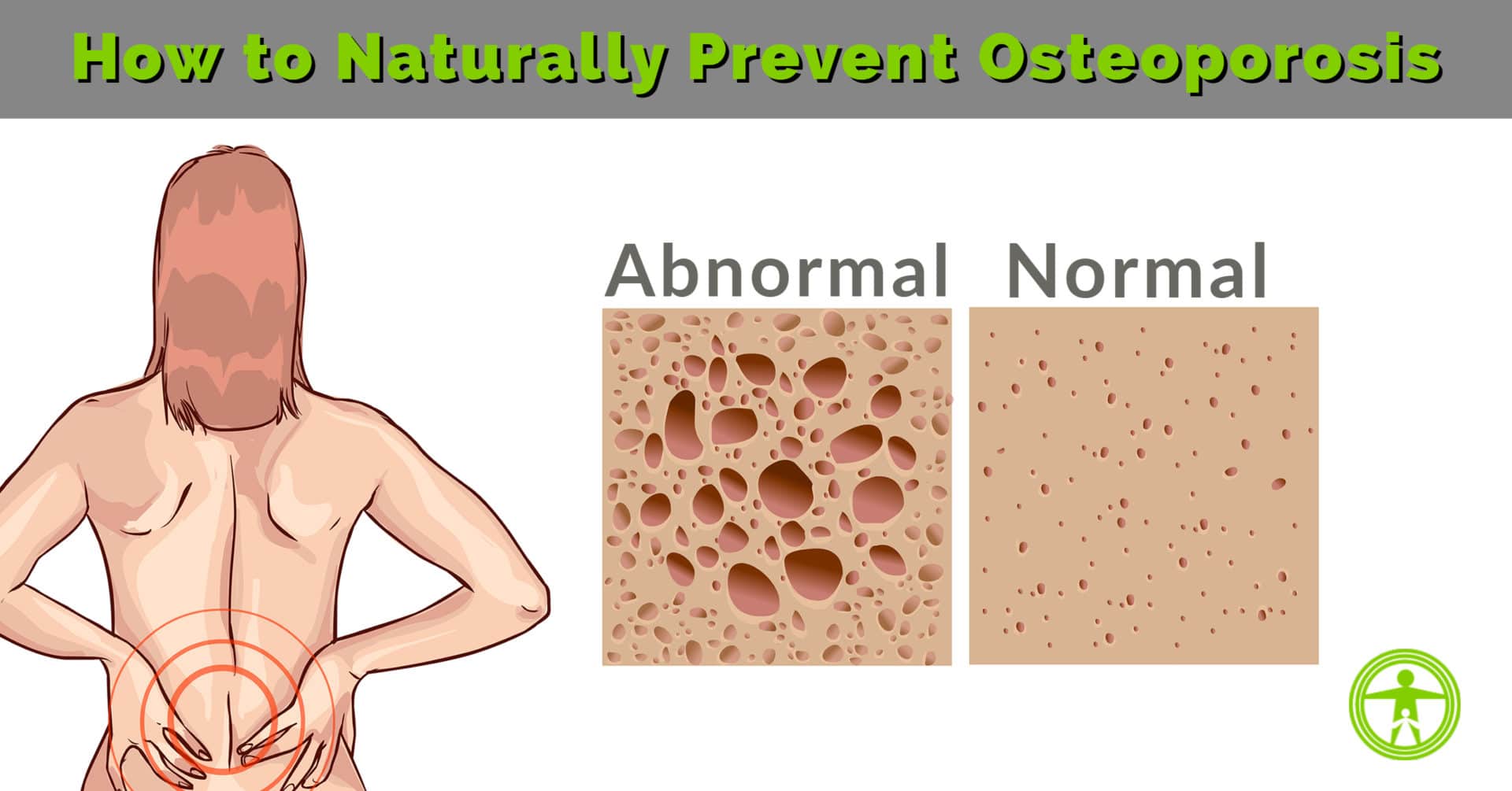
Osteoporosis is a disease characterized by the thinning and deterioration of your bones.

When bones start to lose calcium, they become brittle and break.

But calcium isn't the only mineral you need for strong bones.

Other nutrients include:

  • Magnesium
  • Zinc
  • Copper
  • Manganese
  • Potassium
  • Boron
  • Vitamin C
  • Vitamin K

Calcium is not the most important supplement to prevent Osteoporosis!

Without a doubt, physical activities such as walking, Yoga, Tai Chi ans strength training are some of the most effective means of preventing osteoporosis.

Promoting hormone and nutrient balance are additional steps in preventing osteoporosis.

Bone loss after age 30 increases significantly, which is why age appears to be a huge factor. But just like you should build wealth over time, the same is true with health.

signs and symptoms of osteoporosis

Signs and Symptoms of Osteoporosis

How can you tell you have osteoporosis? Initially, you won’t have any symptoms. However, as this condition progresses you may experience:

  • Bone fractures (especially in the hip and wrist)
  • Low back pain
  • Vertebral compression fracture
  • Loss of height
  • Stooped posture (Dowager or widow’s hump)
  • Gum disease/excessive tooth decay
  • Premature graying of hair (50% by age 40)
  • Leg cramps at night
risk factors of osteoporosis

Osteoporosis Risk Factors

When it comes to osteoporosis, there are some risk factors within your control and then there are those that are out of your control.

Uncontrollable osteoporosis risk factors:

  • Age (>50yrs)
  • Female
  • Menopause
  • Family history

Controllable osteoporosis risk factors:

  • Eating acid-forming foods (excessive meat, coffee, sugar, sodas)
  • Nutrient deficiencies (Ca, Mg, K, D3)
  • Low stomach acid and antacid usage
  • Lactose intolerance
  • Poor gut bacteria
  • Low estrogen
  • Low androgens (DHEA and testosterone)
  • Birth control pills
  • Vitamin D deficiency
  • Sedentary lifestyle
  • Smoking
  • Medication
  • Heavy metals found in the body (cadmium and lead)

Have you noticed that so many more risk factors are in your control?

primary causes of osteoporosis

Primary Causes of Osteoporosis

There is a process of growth called ‘remodeling’ that goes on within healthy bones.

Each bone uses osteoclast cells to break down old and weak bone. And osteoblast cells are used to build new, strong, and healthy bone.

When this process is altered, it signals an imbalance is happening in our body. We are now learning age and a low calcium diet are not the only reasons to blame, but instead an imbalance of the remodeling process.

1. Sedentary lifestyle

The saying “If you don’t use it, you lose it” is so true when it comes to our bones.

Exercise increases the secretion of a thyroid hormone called calcitonin in our body. Calcitonin inhibits osteoclast (bone breakdown) –  yet another example of hormones affecting our bones.

Weight training is especially beneficial for osteoporosis.

One really cool (I think) aspect of the chiropractic adjustment, beyond its effect on joint motion and the central nervous system, is the effect it has on the process of bone breakdown and replacement.

A chiropractic adjustment stimulates the cells that are in charge of replacing bone (osteoblasts).

So when one receives a chiropractic adjustment, they are not only improving joint motion and the health of their nervous system, they are also giving a positive boost to the strength of their bones.

Getting adjusted supports the health of your bones and prevention of osteoporosis, as well as assists in the process of reversing it.

2. Low estrogen

On a cellular level estrogen is needed to inhibit osteoclast (bone break down activity). When you have estrogen deficiency, this speeds up bone resorption causing low bone density – resulting in increased fractures.

Estrogen deficiencies are not only found in postmenopausal women but also include:

  • Young women with amenorrhea (thin athletes, very low body fat, anorexia)
  • Women with bilateral oophorectomy (both ovaries removed)

The same is true with testosterone deficiency in males.

Androgens prevent the loss of bone density and promote bone formation. But we all know the prevalence of osteoporosis in women far exceeds men’s prevalence.

So why is it so important we also focus on a hormonal deficiency in men?

Studies show that the mortality rate in men is significantly higher after a hip fracture than women.

3. Nutrient deficiencies

Bone matter consists of a few things that are needed to give your bones hardness and flexibility:

  1. Calcium and phosphorus crystals
  2. Protein fibers (collagen)

Our bones house the majority of calcium and phosphate found in our body.

Vital nutrients for bone health and their roles:

  • Calcium – maintains bone strength and is the essential building block
  • Zinc – increases osteoblast and mineralization
  • Copper – helps with bone flexibility and strength
  • Magnesium – increases osteoblast and regulates the concentration of Vitamin D
  • Potassium – neutralizes metabolic acids
  • Vitamin C – synthesizes healthy collagen and regulates homeostasis for healthy bones
  • Vitamin D – facilitates calcium absorption in the intestines and critical in bone remodeling
  • Vitamin K – aids in calcium absorption and improves bone turnover

You can see how important all of these nutrients are in building strong healthy bones.

This is why we also focus on these deficiencies in our body – to determine if this could be the cause of osteoporosis.

The easiest way to become nutrient deficient is to not eat enough food in the first place.

4. Lifestyle Habits 

Smoking

To add to the long list of negative effects smoking has on your body –  it also decreases your bone density mass. Smoking increases the breakdown of estrogen in the liver. Smoking also has been proven to cause early onset of menopause in women.

Medications

Drugs like proton pump inhibitors, selective inhibitors of serotonin, hormone deprivation therapy, and glucocorticoids negatively affect bone density – increasing bone fractures.

Alcohol

Alcohol interferes with calcium absorption. So, it is no surprise that heavy alcohol consumption can lead to decreased bone density, bone formation, and increased fractures.

nutritional considerations for osteoporosis

Best Nutrition For Osteoporosis

Start with eating calcium-rich foods:

  • Broccoli
  • Kale
  • Collard greens
  • Bok Choy
  • Shrimp
  • Sardines (with bones)
  • Almond milk

Don’t forget Vitamin D (I use this supplement) is needed to absorb calcium so pair your calcium-rich foods with:

  • Fatty fish, like salmon or tuna
  • Orange juice
  • Egg yolks
  • Cheese

Dairy is also a good source of calcium, but I don’t recommend it due to increased food sensitivities to most dairy products such as milk, cheese, yogurt, and butter.

The dairy industry has created the need for dairy consumption by instilling fear in women that avoiding dairy will cause weak bones. To debunk this, let me offer you this analogy: Traditional Chinese cuisine never used any dairy and historically Chinese women had no problems with osteoporosis (this is changing now with Western food entering China).

Another analogy: cows don’t eat dairy and don’t seem to have a problem with their bones :-).

How to Naturally Prevent Osteoporosis2026-04-26T11:13:32-05:00

What You Should Know About Pain

Have you ever had a nasty paper cut that resulted in the worst pain you've ever felt?

Or maybe you stubbed your toe and that blinding “I'm going to die right now” pain shot right into your brain.

And then there's instances where people can have broken limbs or there's cases where people's knees and hips were so deteriorated that their bones were literally grinding together, and yet they didn't feel it.

Why is it that?

How can our bodies become so damaged and diseased and we are completely unaware of it?

Why is it that you can be strolling about your day, and then all of a sudden you cannot stand up straight because your spine is in excruciating pain?

What these simple differences tell us is that pain is a rich, complex experience.

Pain involves not just the physical experience of some injury (or threat of some injury), but, according to research over the past 30+ years, pain involves processing stimuli from various inputs, including social, psychological and physiological experiences.

core exercises you should do

Pain is Just Information

Research in pain indicates that the electro-chemical signals from an injury do not always say “I'm feeling pain” to the brain.

Rather, these same signals that yell at your brain “I'm in pain” today, can instead be translated as “I'm just frustrated” tomorrow.

In other words, pain is cognitive.

This means pain is interpreted by the brain using multiple streams of information – including physical, social, psychological and environmental inputs – and then decides whether the combined output says “Help, I'm in pain.”

At its most fundamental level, we can say that:

1. Pain is not the same thing as an injury.

2. Pain takes place not at the site of injury, but in the brain.

Research also tells us that the brain interprets specific signals as pain when it perceives something to be jeopardizing enough to the body’s balance (homeostasis).

Likewise, the role of pain seems to be an action signal: a signal that, if perceived, means something needs to be changed to restore the body’s homeostasis.

This gives us a third point:

3. Pain is a signal to change.

One of the challenges for treating pain is that the site of pain is not always the source of pain.

In fact, the pain in your shoulder could really be due to imbalanced hips or a bad ankle!

If you felt like you could tackle the world one day, and then your “back is out” the next day, that's a big signal that you need to change something in your daily habits.

But remember, pain is simply a brain signal and doesn't necessarily tell us what is wrong with your body.

core exercises you should do

Acute (immediate) vs Chronic (long term) Pain

Generally speaking, pain breaks down into two categories: Acute and Chronic Pain.

Acute pain

According to the International Association for the Study of Pain (IASP), acute pain would be a sudden back twinge during deadlifts, or twisting your ankle on an uneven sidewalk.

Acute pain is usually going to be associated with an injury and is site specific. It could be described as “damaging pain”.

This type of pain is sharp, shooting, burning and well defined. It's also usually accompanied by swelling and heat.

Chronic pain

Chronic pain is more nonspecific and nagging. It's that pain that's been around for a year and doesn't impact you too much; but it's still a problem.

Chronic pain tends to be more diffuse. But chronic pain can be intense. Some day's your chronic pain will be at an 8 out of 10, whereas other days its down to a 1 or 2 out of 10.

The distinguishing feature is that it's not associated with an injury and changes abruptly.

People with chronic pain tend to reduce their movement (to avoid or get rid of their pain), and even fear certain types of movements; which of course causes problems.

Chronic pain can also coincide with inflammation, but there may be no physical signs that there is any particular tissue repair work going on.

All that said, in both acute and chronic pain cases, pain-free movement will always accelerate healing and break pain cycles.

the bottom line of core exercises


Fix Your Pain by Optimizing Movement

Movement is a key signal to our bodies about how well we’re doing.

In fact, I'll go so far as saying that movement is a nutrient that your body needs to survive; just like oxygen, water and food.

We are designed as “use it or lose it” systems, constantly adapting to what we do (see Woolf’s Law for bone formation and Davis’ Law for tissue).

Abnormal movement causes wear and tear and arthritic changes to your structure (bones and soft tissue)!

Our bodies adapt to the demands — or lack of them — they experience. This is literally why exercise or strength training is so important.

If we don’t move something for a while, our bodies begin to adapt to support that lack of movement. So unused bone disappears and unused muscles atrophy.

Even things like balance and coordination will diminish if we don't practice them.

Our bodies compensate in other ways too, to make up for the lack of mobility and we often get new pain as a result of those compensations.

For instance, our joints may swell, or muscles may stiffen when asked to do work they are not designed to do.

Another example could be the pain you have in your right hip.

  • If it stays there long enough, you'll start favoring your left leg to compensate.
  • While this makes your right hip feel better (sort of), you eventually get pain in your left leg and hip, because you’re suddenly doing much more unbalanced work on the left hand side.
  • Then, maybe your right shoulder starts to hurt, or your neck, because you’re walking around lopsided like a boat with one oar, and it’s pulling on your spine.

Here’s another common example:

Your body becomes less flexible and weaker over time (because let's face it, you don't exercise or work on yourself as much as you should).

  • Your gait (or walk pattern) starts to change because your muscles are less flexible and limber
  • Eventually you're not bending over or lifting things as you should.
  • One night you go to bed and then wake up with severe back pain.
  • This pain is the worst pain you've ever experienced and all you want to do it lay down all day.
  • After a few days of lying around, you feel worse.
  • Maybe your shoulders and neck start to hurt too.
  • Your hips even start to hurt from the pressure of lying down.
  • Eventually your pain goes away, but the dysfunctions to your neck, shoulders and hip are still there… patiently waiting

Not moving is not a great solution!

Thus, immobilizing yourself can create a vicious cycle.

Compensating for one painful movement induces other restricted movements.

But by staying as mobile as possible, moving every joint, without pain, we signal two things.

First, movement says we are still using this part of our body and thus this body part needs resources for healing and growth.

Second, the movement signals themselves can overwhelm a pain signal to say there’s more right than wrong going on in the area: there are more nerves that tell the body how we’re moving than nerves that say there’s something wrong.

Movement nerves (mechanoreceptors) are also easier to turn on than nerves that trip in the presence of noxious stimuli.

This is why you can't help but jump up and down when you hurt yourself.

Movement overcomes pain signals. It's as easy as that.

the bottom line of core exercises


In Summary

If you’ve experienced fresh or ongoing pain, it may help to seek out a movement assessment.

This means being assessed in motion.

From the bottom up, a movement assessment would evaluate ankles, knees, hips, low back, mid and upper back, shoulder and neck mobility and flexibility.

The basics of a movement assessment include a head to toe visual exam of the most basic and fundamental movements such as:

This guidance may seem obvious, but it’s not in practice.

Many of us have seen specialists that will look at how a painful limb moves, or test our range of motion while lying on a table or standing still, but may not consider how we carry ourselves as we walk down a hallway.

Likewise, some approaches may deal only with musculo-skeletal issues.

If that works, great, but if it does not, that may be a sign that some other part of the somatosensory system is not functioning well.

This means it could be strength and balance problems or your ability to recover. There could be emotional signals and or biochemical imbalances.

But above all, pain is simply a signal to change. It means that what you're doing right now is not working.

And until the underlying issue is identified and addressed, the signal to change may keep coming.

If you're experiencing acute or chronic pain, then consider getting checked by a movement based professional who understands the complexities involved.

What You Should Know About Pain2026-04-26T11:13:32-05:00

The Best and Worst Core Exercises

Why You Should Fix Your Foundation

Core Exercises are a topic that undoubtedly comes up when someone struggles with back pain or is interested in strengthening their spine.

Back injuries are the most common of all orthopedic injuries and they happen in gyms and the workplace quite a bit.

Unfortunately, when someone hurts their back, they tend to do movements, stretches or core exercises that cause more harm than good.

Most people have degeneration in their spines, but only some people are symptomatic or feel pain, muscle spasms and discomfort.

In fact, herniated discs, bulging discs and spine degeneration (arthritis) are all very common, yet few people are aware they have it until their nerves become so inflamed and irritated.

And when this happens, you'll say things like, “My back is out!”  Usually this causes you to go to the doctor.

Most doctors have no clue what's happening so they'll prescribe anti-inflammatories, cortisone shots or muscle-relaxers.

This can help, but it certainly won't fix the problem.

And when you get frustrated enough with the pain and discomfort, you'll get some imaging done such as X-rays or MRI's.

And that's when you find out that your spine is in pretty bad shape.

But getting a diagnosis of a bulging disc, herniated disc or spine arthritis isn't going to fix anything either.

This degenerative process has been going on for years.

The problem builds over time due to repetitive trauma (poor posture, poor movement or lack of proper training and exercise, unhealthy lifting technique, etc.).

The reality is…

If you don't fix the foundation of your spine (i.e. improve core muscle function, change your posture and poor movement patterns), you'll have these up and down, “I've thrown my back out again” moments forever.

The notion that strengthening the core is all about your abs or doing more sit-ups is dated. In fact, the abs or rectus abdominus make up a tiny fraction of what we need to strengthen and balance.

The core musculature or “Foundation Muscles” include:

  • Pelvic Floor Muscles
  • Transversus abdominus
  • Multifidus
  • Internal and External Obliques
  • Rectus abdominus
  • Erector Spinae
  • The Diaphragm
core exercises you should not do

Core Exercises You Should Not Do

When it comes to understanding back pain, there is one person that likely knows more than anyone else on the planet.

According to Dr Stuart McGill, a back researcher (spine biomechanist to be exact), all the research to date on the role of our core musculature comes down to a few “Do's and Don'ts”.

Of all the muscles that are part of the core, here's the few that matter most:

  • Abdominal muscles– rectus abdominis (the six pack), transverse abdominis (muscle underneath the six pack), obliques; internal & external (muscles on either side of the six pack)
  • Lower back muscles – back extensors and quadratus lumborum
  • Upper back muscles – latissumus dorsi (lats)
  • Psoas muscle – muscle that runs from the front of the back to the upper leg

The quadratus lumborum (QL) is probably the most important muscle for back health you don’t know about.

It’s attached to each the vertebra of your lower back (lumbar vertabra), your rib cage, and your hip (pelvis) and it’s involved in bending your body to the side (lateral flexion), but for the most part doesn’t change in length too much. By being attached to every vertebra, the QL provides support to each vertebral joint and seems to have a unique ability to stabilize the lower back.

The core acts as a support system to your spine.

When we move, all the muscles of the core contract at the same time (co-contraction) to buttress (Dr. McGill’s word) the spine.

Core Exercises You Should Not Do

According to Dr. McGill, these are core exercise no-nos:

1. Lower back stretching 
This decreases back stability and stresses the discs of the back.

2. Traditional crunches
These stress discs of the back and don’t activate the core properly.

3. Sucking in to activate your transverse abdominals
This doesn’t properly activate the core and in many people, doesn’t provide enough of a challenge.

4. Forward bends first thing in the morning
The discs in your back have extra fluid in them in the morning (after lying down all night) so they are more likely to rupture with the extra pressure.

core exercises you should do

The Best Core Exercises for Back Pain

Training the core is where most people get into trouble, because they try to train the core like any other body part — with heavy weights, or a full range of motion.

However, the key to core training for a healthy back is muscle endurance (not strength) and stability (the ability to brace, not move).

In most day to day activities and the sports we play, the core’s job is to stop movement.

For example: You open your car door — your core stops your spine from twisting as you pull the door open with your arm. You kick a soccer ball — your core stops you from keeling forward.

Pause for a moment and think about what that means.

You want your core to be stable and resist movement. So why are we stretching, overbending, and turning ourselves into pretzels?

Core exercises you should do

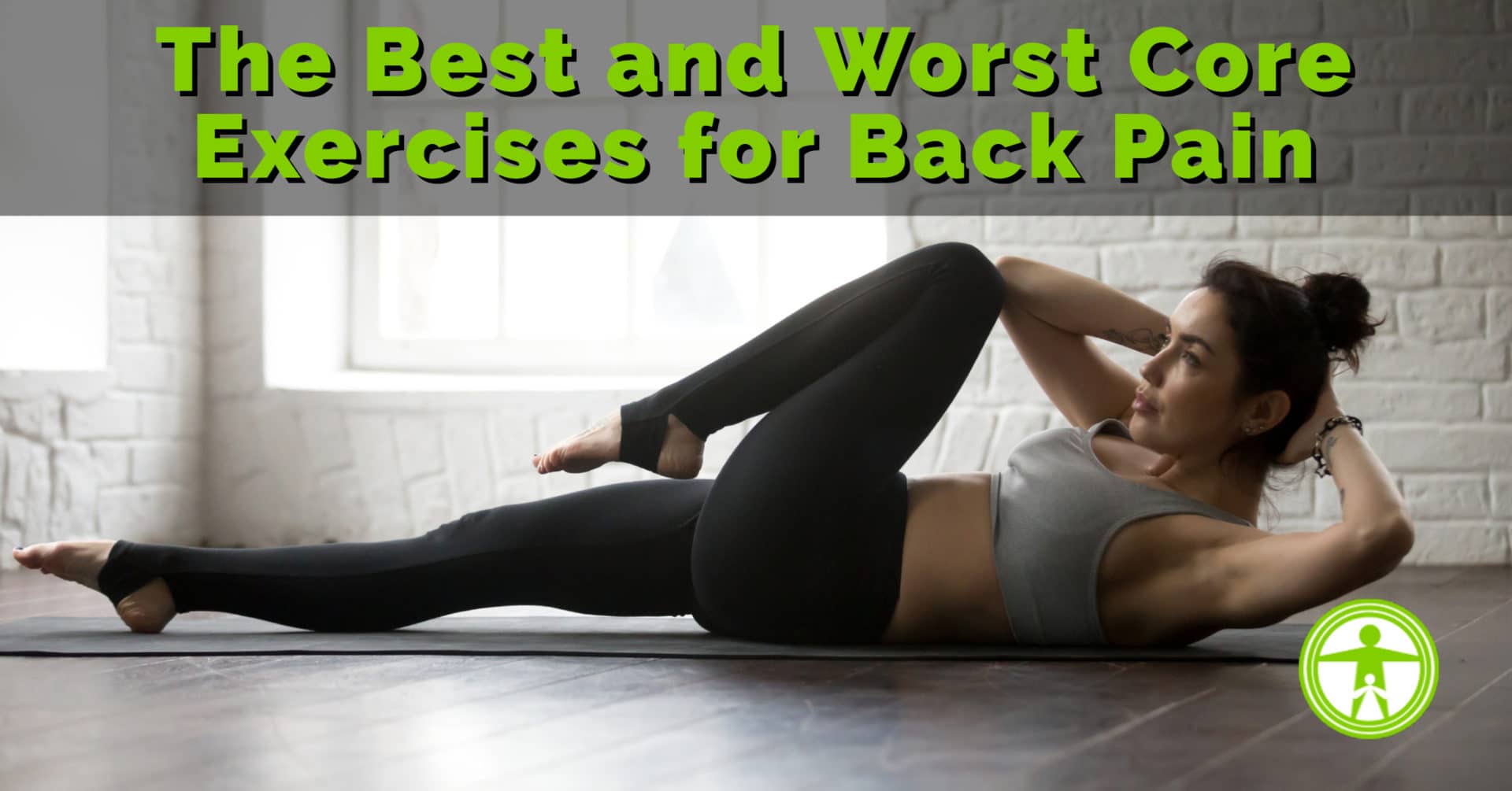
There are four exercise Dr McGill prescribes for back health: Modified curl-up, stir the pot, side bridge and bird dog.

  1. The modified curl-up is different from a regular curl up because one leg is bent while the other is straight; the hands are under the lower back and only lift the head and neck.
  2. Stir the pot is a plank-type exercise done on a stability ball with the added challenge of stirring the pot (moving your arms as if you’re trying to stir a large pot). If that is too hard you can just do a plank on the ball or even on the floor.
  3. Side bridge is a side plank from the elbows.
  4. Bird dog starts on all fours, like a dog. You lift the opposite arm and leg, focusing on stiffening the core. To make this harder instead of just lifting your arm and leg straight up and down, make squares at the top of the movement.

Here's a video walking you through it all:

Specific things to focus on while performing these exercises:

  1. Keep the tightening (isometric) part of the exercise to 10 seconds and add reps to progress in the exercises.
  2. Maintain form – once you can’t keep your spine tight, stop.
the bottom line of core exercises

The Bottom Line for Core Exercises

Your core’s most important function is to stabilize your back and it works by simply cocontracting the muscle that makes up the core. No movement happens.

Stretching your lower back goes against what the core is trying to do – stabilize (the opposite of flexible/mobile/instable). Avoid stretching your lower back and bending at the spine; stretch the muscles around your hips and bend at the hip rather than the back.

Muscle endurance, not muscle strength, is what is important for back health. I’m not saying you shouldn’t train for strength, but that since your core muscles have to keep your back protected for hours at a time, endurance should be your goal for protection.

You might think you’re too advanced for these exercises to help, but you’ll be surprised, since most people train strength and not muscle endurance. If you are currently having back pain, go to a doctor before starting these exercises.

Bottom line

Whether you’ve had back pain in the past or not try these four exercises — modified curl-up, stir the pot, side bridge and bird-dog — every day for the next few weeks.

You have nothing to lose but some pain and spinal instability.

If doing these exercises doesn't help, and you have not had a proper spine examination, then that's the next and most important step!

The Best and Worst Core Exercises2026-04-26T11:13:33-05:00

Five Benefits of Chiropractic Adjustments

Chiropractic Adjustment Benefits:

5 Reasons Why You Should Get Adjusted Regularly

Chiropractic Adjustments are small, specific forces directed to the spine to restore proper movement and function. In this article we share 5 scientific papers highlighting the significant of chiropractic adjustments.

1. The Spinal Cord Impacts Disease Processes

The work of PhD Neurophysiologist Irvin Korr involves 5 decades of his life studying the spine and its direct influence on the nervous system.

In 1976, he published a series of papers with many references pointing to the fact that an alteration in a segment or area of the spine absolutely negatively affected nervous system function.

The article was titled “The spinal cord as the organizer of disease processes” (1).

Now I know Dr. Korr was not a Chiropractor and even went on to embrace the osteopathic profession before really understanding the chiropractic philosophy and science, but his work on understanding the relationship between the spine and nervous system is profound. In fact he published so many articles in his career and had such an influence in spine and neural physiology that the eulogy in his funeral was also published in PubMed…WOW!)

Most of his work helps validate the power of a chiropractic adjustment. Korr even experienced this first hand when his health was slipping in his 40’s and he was treated by spinal manipulation.

After one treatment he went for a walk and found an irresistible urge to break into a jog, which he hadn’t done in years. From that moment he described a transformation in his life!

Korr attributes his long life (lived into his mid 90’s) and prolonged intellectual activity to having received quality traditional osteopathic and chiropractic spinal adjustive care.

Dr. Roger Sperry, a nobel prize winner on brain research, said “90% of the stimulation and nutrition to the brain is generated by movement of the spine”!!

Korr helped prove that the spine was much more than just a structure that helped us stand more erect and protected the spinal cord. He was also unique and inspiring as he always pointed out we as humans express our humanness by choosing to do such things as play the piano, ski, walk, etc.

He pointed out the importance of taking care of the “whole person” in healthcare instead of the reductionist viewpoint of picking out just a diseased organ or part like the allopathic physicians practiced.

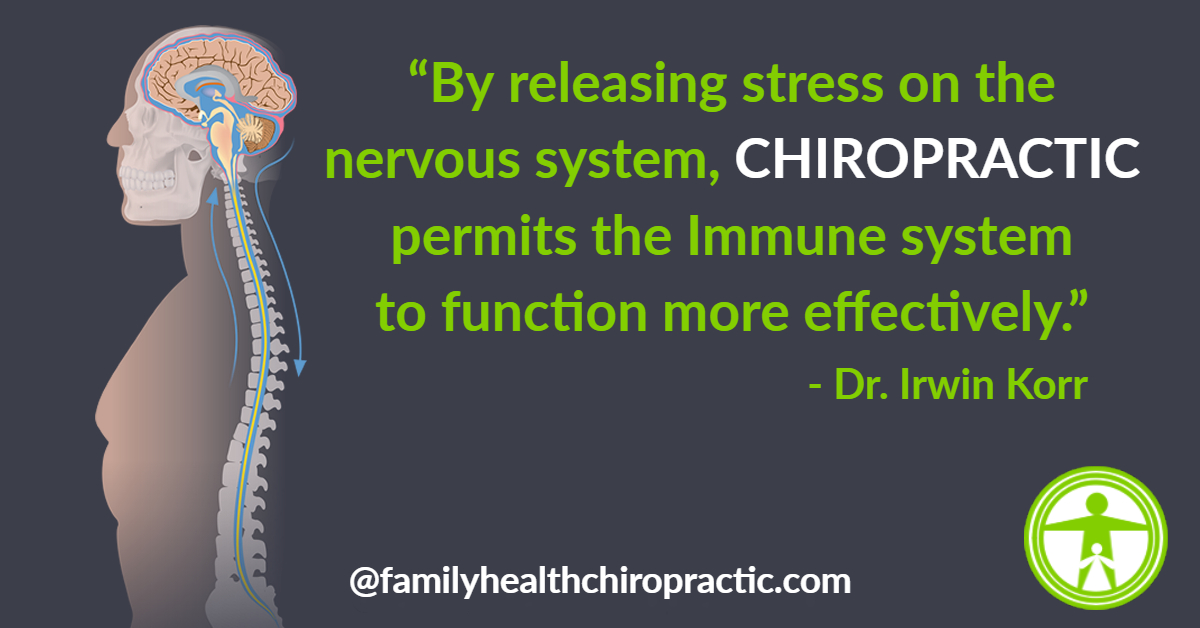
The bottom line in the work of Korr was how he showed that a misalignment in the spine creates a stress that negatively impacts the nervous system.

This increased stress leads to overactivation of our “fight or flight” system and negatively impacts overall health physiology.

Reference:  “The spinal cord as organizer of disease processes” Korr IM. J Am OsteopathAssoc. 1976 Sep;76(1):35-45.

2. Chiropractic Adjustments Positively Impact Brain Function

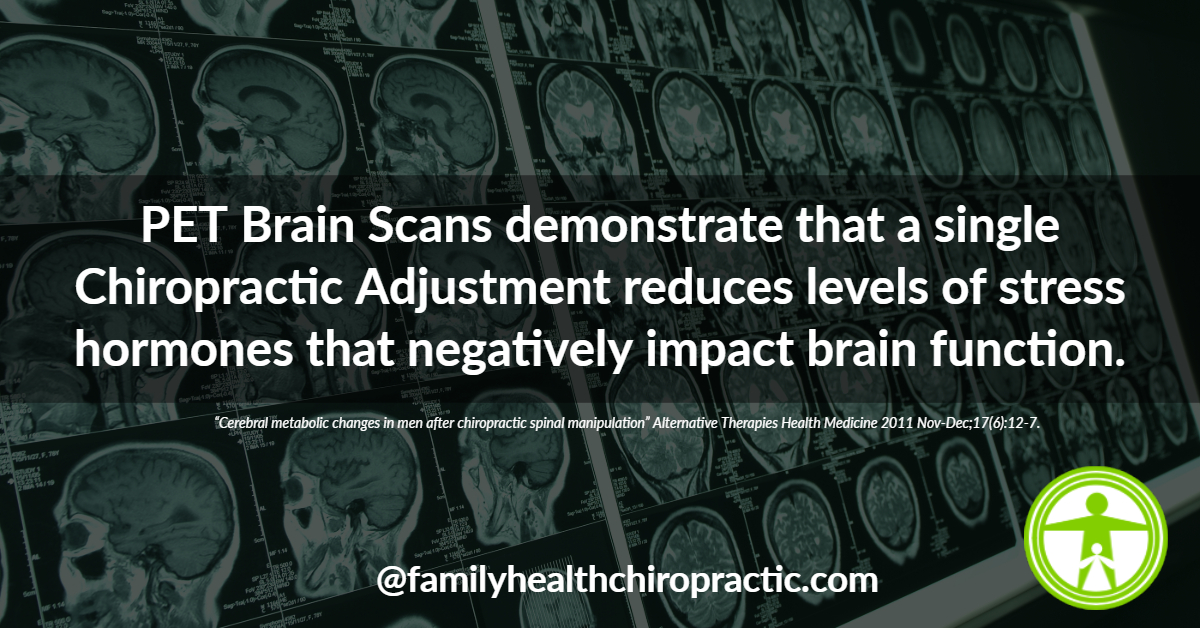
A study performed in 2011 revealed the impact of one single chiropractic adjustment on the brain and nervous system.

Published in “Alternative Therapies Health Medicine” (2), this study was done by 8 PhD’s and 1 Chiropractor.

They used a PET scan as a powerful neuro-imaging technique to measure neuronal activity in the brain.

They were able to take a radioactive analogue of glucose as a marker to measure brain glucose consumption as it would indicate brain metabolic activity post-adjustment.

Their findings were ASTONISHING!!

The study clearly demonstrated that the sympathetic tone of the nervous system was inhibited, salivary amylase was decreased (indicating a decrease in fight/ flight physiology), regional brain metabolic changes occurred, and muscle tone & pain intensity decreased following ONE single chiropractic adjustment.

Let me tell you what this means…

Studies dating back to the Windsor autopsies in 1921 up until now have claimed that spine strength and integrity and health impact nervous system function…

THIS STUDY PROVES IT!

But the mechanism behind this study would not indicate a hard bone impacting a nerve.

Rather, it backs the plausibility that decreased segmental movement and abnormal alignment of the spine creates abnormal signals into the brain (specifically the hypothalamus) leading to increased sympathetic tone (flight/flight).

Increased sympathetic tone always increases stress hormones (because of the direct link from spinal mechanoreceptors to lamina 7 of the spinal cord and then up to the cerebellum, thalamus, cortex, and then hypothalamus) as the spine has the ONLY direct link to the Hypothalamus (and thus hormones) in the entire body.

Taking this a step further, chronic increased stress hormones are linked through numerous studies directly to a host of diseases including but not limited to cancer, glaucoma, bi-polar disorder, type I & type II diabetes, rheumatoid arthritis, autoimmune disease, osteoarthritis, excessive body weight, hypertension, asthma, immune system function. (“Autonomic and Autocoid Pharmacology” 2009)

Reference: “Cerebral metabolic changes in men after chiropractic spinal manipulation” Alternative Therapies Health Medicine 2011 Nov-Dec;17(6):12-7. 

3. Chiropractic Adjustments Are Good For You Regardless of Symptoms

This 3rd Study published in the “Journal of Neurophysiology”(3) showed that a cervical spinal adjustment (ON PATIENTS WITH NO PAIN) influences the cortical brain and can create neuroplastic changes in the brain tissue.

There are counselors and emotional modification programs that cannot create neuroplastic changes in the brain over months and months of therapy like one single chiropractic adjustment can.

I believe the best part of this study is that the subjects receiving adjustments DID NOT have neck pain but had confirmed misalignments. (In other words…the spine was misaligned and undergoing damage in the absence of pain)

How many people who never have pain, think about getting chiropractic adjustments? Just because you don't have pain or hurt doesn't mean your healthy.

This particular study proved that a chiropractic adjustment had a direct influence on sensory input into the brain that positively changed it.

It was noted that “enhanced active inhibition” of the sympathetic nervous system tone occurred in ALL post-adjustment measurements!

The other cool thing it proved was that it clearly wasn’t a placebo effect or just “laying on of hands”.

One group was set up for an adjustment but the high velocity low amplitude thrust was not made and this group had NO cortical neuroplastic change.

The bottom line here is that the spine misalignment leads to a bombardment to the Central Nervous System with afferent signals from joints and surrounding muscles.

A chiropractic adjustment reduces excessive signals and improves altered input into the brain and spinal cord, resulting in better adaptation to any internal or external input the brain perceives.

Truth is…

  • There is no way to be healthy without a healthy spine.
  • There is no way to know if you have a healthy spine unless you have it checked (regardless of pain or symptoms).
  • Chiropractic Adjustments are proven to positively impact your brain and spinal cord for improved health.

Reference: Haavik Taylor, H. & Murphy B.A. (2007) “Cervical spine manipulation alters sensorimotor integration: A somatosensory evoked potential study” Journal of Clinical Neurophysiology, 118(2):391-402 

4. Chiropractic Adjustments Improve Posture

The next study I want to cover is one of my favorites.

This was a study published in the reputable Medical Journal of SPINE in 2005 and was done by a team of all Medical Doctors headed up by Dr. Steven Glassman.

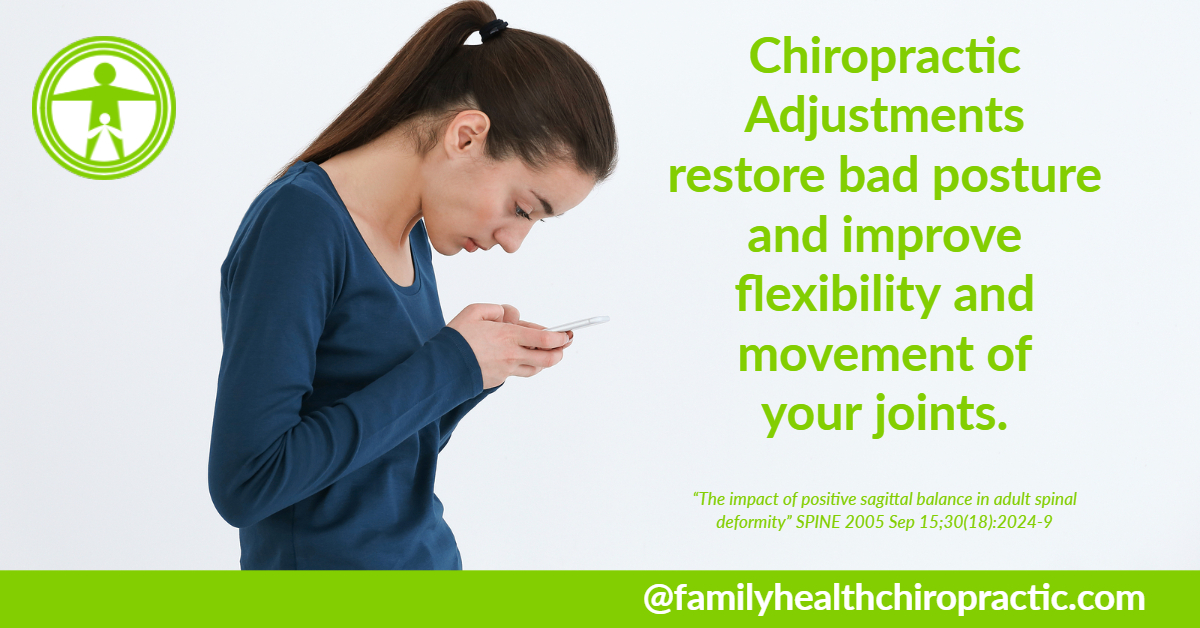
They measured posture in 752 subjects from the sagittal plane (from the side) using full-spine x-rays.

They took measurements from C7 (the 7th bone in your neck) and took plumb-line measures as it relates to the sacrum.

Basically, the more forward C7 was in relation to the Sacrum, health status was decreased significantly.

ALL MEASURES OF HEALTH STATUS showed significantly POORER SCORES AS POSTURE DEVIATIONS INCREASED.

This is why we evaluate posture on every single patient!

Even minor forward head posture was shown to be detrimental to health.

From breathing and heart rate, to pain and disability, all health markers that were measured worsened as the posture deviations increased.

This again clearly demonstrates the relationship between a bad spine (spine misalignments) and its implications on human health, particularly as it relates to non-musculoskeletal physiology.

All Chiropractic adjustments help to restore posture by improving motion and spinal integrity which improves afferent input into the spinal cord and brain, thus, allowing the body to comprehend and balance itself better in relation to gravity.

Reference:  “The impact of positive sagittal balance in adult spinal deformity” SPINE 2005 Sep 15;30(18):2024-9

5. Chiropractic Adjustments Are Beneficial For Children

The 5th study you should know about the power of chiropractic adjustments involves kiddos and even newborns.

This paper comes out of the Journal of Manual Medicine and was published in June 1992 (5).

This is a critical piece to understand as it relates to why infants and children need chiropractic evaluations and care if necessary.

The study evaluated more than 600 children, all less than 2 years of age. In this research they refer to the spine misalignments as a “kinematic imbalance due to suboccipital strain” (KISS).

The report talked about the pathogenic importance of asymmetric posture in small children and the fact it is often played down – if recognized at all by the medical community.

The author noted that KISS (spine misalignments) has a wide range of clinical signs and in many cases can be dealt effectively with manual therapy.

The risk factors for why these children had KISS syndrome, as they called it, were from intrauterine misalignment, application of extraction aids in delivery, prolonged labor, and/or multiple fetuses. (In short, BIRTH itself was the Cause!)

When someone asks me if their newborn or child should get adjusted, this paper is the first thing that comes to mind.

WHY INFANTS AND KIDS NEED CHIROPRACTIC!

Lets look at the facts of the study.

First off, they agreed that the main symptoms that KISS syndrome can lead to are:

  • torticollis
  • unilateral face asymmetry
  • C-scoliosis
  • motor asymmetries
  • unilateral retarded maturation of hip joints
  • slowed motor development
  • sleeping disorders
  • neck sensitivity
  • face swelling
  • fever of unknown origin
  • loss of appetite
  • feet deformities
  • pathological reflexes
  • range of motion diminished by 30% or more

They concluded that on these babies “an A-P radiograph of the upper cervical spine is imperative.”

The radiograph evaluation helps to find malformations and aids in determining the direction of the adjustment.

THERE WAS NO CORRELATION BETWEEN EXTENT OF THE ASYMMETRY AND THE SYMPTOMS OR SUCCESS OF THE TREATMENT!

This means that even a small shift or misalignment is clinically relevant.

The treatment involved an “impulse adjustment” and in most cases the direction and line of drive was determined by radiological findings (85% of the time).

6 HUGE findings in this study:

  1. “Selection of the direction of adjustment without x-ray seems the most plausible cause of the less encouraging results of some colleagues.” This means x-rays helped get better results. Interesting, but I don't like Xray-ing babies less than 3 years of age!
  2. THE RISK OF TREATMENT WAS MINIMAL! No serious complications were encountered. Most children would cry for a moment but stop as soon as they are in their mother’s arms. In 2 cases (out of roughly 600) the children vomited after the adjustment but had no negative effect of outcome in either case.
  3. It was noted that the UPPER CERVICAL SPINE REMAINS A WEAK SPOT IN MOST CHILDREN which is why they should be re-examined before they start school at age 6.
  4. KISS is not confined to local complaints or even mechanical symptoms and is not taken into account when these children show signs of restlessness and concentration difficulties.
  5. KISS DOES NOT ALWAYS LEAD TO CLINICAL SYMPTOMS
  6. Upper cervical “delicate structures undergo considerable stress during delivery” and during delivery “a majority of newborns suffer from micro-trauma of the brain stem tissues in the periventricular areas.” (The CAUSE is “Normal” Births)

***Another interesting side-note from this study was that the adjustment of the occipital/cervical region led to disappearance of problems that the parents had not reported because they did not see a connection with the spine. (I CANNOT TELL YOU HOW MANY TIMES DO WE HEAR THIS IN PRACTICE?)

And these parents would regularly note that their child would eat or sleep much better since the treatment.

WHO NEEDS TO KNOW ABOUT THIS?

EVERYONE!

Reference:  Biedermann H. “Kinematic imbalances due to suboccipital strain in newborns” J. Manual Med (1992) 6:151-156. 

Five Benefits of Chiropractic Adjustments2026-04-26T11:13:34-05:00

Types of Physical Therapy

Types of Physical Therapy

Corrective Exercise Specific to Your Rehab Needs Leads to Functional Improvements

We offer some of the best physical therapy Austin, TX can offer, addressing injuries induced by both chronic stress and physical trauma. For example, Carpal Tunnel is a common condition that people who live in Austin see Dr. Daniel Gonzalez about. Whether it's due to compressed nerves, repetitive stress disorders, arthritis and or neck problems, we are confident that we can help! Injured in sports, exercise, or an accident? We can help with those, too. We'll address the pain and help you build a manageable program of exercise, stretching, and other techniques to restore function.

At Family Health Chiropractic, we offer various forms of some of the most effective physical therapy Austin, TX has to offer. Treatment modalities include manual therapies, therapeutic exercises, and neuromuscular re-education.

Physical therapy is used to help correct and restore neuromusculoskeletal function including flexibility, mobility, strength, and balance. As the best physical therapist in Austin (just check out our reviews) we are confident we can improve your symptoms and help you work to restore function.

Loss of proper muscle and joint function are common effects that can lead to injury and/or be a result of an injury. Therefore, it is extremely important that physical therapy is considered as a part of your overall treatment plan. This form of therapy has been shown to be most effective in helping to improve function in more long-term, chronic conditions (ones where symptoms are present for at least 3 months). It also has a role in helping to prevent future recurrences of injury.

If you are in or near Austin and looking for a physical therapy nearby, come see us for a consultation. We look forward to helping you feel (and be) better!

Manual Therapy

Manual therapy techniques are skilled hand movements and skilled passive movements of joints and soft tissue and are intended to improve tissue extensibility; increase range of motion; induce relaxation; mobilize or manipulate soft tissue and joints; modulate pain; and reduce soft tissue swelling, inflammation, or restriction. Techniques may include manual lymphatic drainage, manual traction, massage, mobilization/manipulation, and passive range of motion. The range of techniques and personalized plans we create are one of the secrets of our reputation offering some of the best physical therapy Austin, TX has available.

Therapeutic Exercises

The first goal of any therapeutic exercise plan is to reduce pain and inflammation.

Next, the goal may shift to regaining range of motion, rebuilding muscle strength, and developing endurance.

Therapeutic exercise programs may include:

  • Strengthening exercises: To develop strength, the emphasis is on heavy resistance and a limited number of repetitions.
  • Endurance exercises: To develop endurance, large muscle groups are engaged for a longer period of time.
  • Flexibility exercises: To develop flexibility, stretching and movement are emphasized.
  • Balance and coordination exercises: To develop balance and coordination, the emphasis is on center of gravity.
  • Functional movement assessment: The Selective Functional Movement Assessment (SFMA) is a movement-based diagnostic system that assesses seven movement patterns. This system quickly identifies the root cause of musculoskeletal pain symptoms, allowing providers to select therapeutic exercises that will address the underlying problem.

Neuromuscular Reeducation

The American Medical Association defines neuromuscular reeducation as the use of therapeutic exercise techniques to improve impaired movement, balance, coordination, decreased kinesthetic sense, and impaired proprioception (sense of one’s location in space). Two key approaches for neuromuscular reeducation therapy are proprioceptive neuromuscular facilitation (PNF) and muscle energy techniques (MET).

Proprioceptive Neuromuscular Facilitation (PNF) retrains the nervous system in two ways. First, it stimulates proprioceptors, which are receptors in joints that relay information about the body’s position through the nervous system to the brain. Second, it uses a particular pattern of stretching to help increase movement. PNF can be a particularly effective treatment modality. Patients who are in pain are often unaware of the various ways that their bodies compensate for that pain, and these unconscious adaptations can introduce new sources of pain. The stretching patterns and sense of body positioning can help make patients aware of the unhealthy, painful postures and promote greater strength and flexibility.

Muscle Energy Techniques (MET) is a form of active resistance that involves a patient resisting a gentle force that a provider applies. Contracting muscles against the provider’s resistant involves an active, voluntary action on the part of the client that engages higher brain function. The idea behind this technique is that involvement of higher brain function empowers the client, making the patient an active part of the treatment process, which can result in changing chronic pain patterns. MET has numerous positive benefits for injured tissues. It stimulates the growth of new cells, helps realign and strengthen connective tissues, lengthens tissues if necessary, increases range of motion, and balances muscle strength across joints. Overall, it provides a gentle alternative to traditional manipulation.

Physical Therapy In Austin

If you live in the Austin area and are in need of physical therapy near you, let Dr. Daniel, the best physical therapist in Austin, help you figure it out!

Here at Family Health Chiropractic, treatment is only the beginning of how we can help you live a happy, healthier life. We're on a mission to make our community healthier and even more dynamic.

Click here to sign up for a consultation with Austin’s Best Chiropractor today!

Types of Physical Therapy2026-04-26T11:13:34-05:00

Why Everyone Should Lift Weights

Why Everyone Should Lift Weights

I'll say it plain and simple: you should be lifting weights.

But not for the reasons that most people think.

For example, I don't believe that strength is the main benefit of weight lifting.

Don't get me wrong. I love being strong but there is way more value in weight lifting than simply gaining muscle or burning fat.

When I think about the value of weight training and what it means for me physically and mentally; it's a no brainer.

Exercise is the closest thing to a miracle drug [1, 2, 3] and strength training is one of the best kinds of exercise, practically like magic: more healthy and more efficient than most people realize, and a valuable component of fitness and most injury rehabilitation.

But why don't more people pump iron?

Aside from the gym-addicting, load-bearing exercises that bodybuilders love, nearly everyone else ignores strength training, except during the occasional New Year’s resolution phase, or when prescribed and/or supervised by a therapist or trainer.

In this article, I will share a few reasons why strength training really matters to ordinary folks and not just the bro's.

While I hope anyone who’s ever spent time in a gym will find this helpful, it’s especially written for people with chronic pain and stubborn injuries who are wondering: Where does strength training fit into my recovery plan?

3 Benefits of Weight Lifting Most People Don't Think Of

Over the past 10 years, I have come to love strength training for many reasons, but not exactly the conventional ones.

1. Lifting Weight Gets You Stronger Mentally

First, pushing yourself physically is a way to measure yourself mentally.

This is also why I like running.

Sure, there's cardiovascular benefits, but the challenge of endurance training and the satisfaction of pushing myself beyond what I'd normally do, gives rise to so much more than physical health.

The same is true with strength training.

Challenging your own body is the greatest method for discovering the strength of your mind.

There will be days when you don't feel like walking into a gym.

There will be sets that you don't feel like finishing.

There will be times when everyone else in the gym will see you fail.

But if you keep showing up anyway, then you'll develop the mental fortitude to get past failure, work when you don't feel like it, and discover what you're really made of mentally and physically.

2. Lifting Weight Training Solidifies Your Self Worth

Something you will absolutely learn from a year of lifting weights at the gym… it doesn’t matter how much weight you can or can’t pull; what matters is that you can grow, build up strength, tweak and experiment with whatever’s necessary to get better.

You will realize that you're not defective.

There’s confidence that comes with that — wisdom enough to know when it’s too much weight, confidence enough to know what you can do.

Confidence changes the kinds of thoughts you have.

There is nothing more personal than your own body. Having confidence that you can move yourself through physical space with control and competence is a deeply satisfying feeling that filters into every other area of life.

3. Lifting Weight Gives You Opportunities to Contribute in Life

Health brings a freedom very few realize, until they no longer have it.

This freedom — this enhanced ability to explore, create, connect, and contribute to the world around you — is one of the greatest benefits of weight training.

This is one of the biggest benefits of weight training: it enables you to transform into a better version of yourself (more confident, more self–aware, more mentally and physically strong), so that you can become a better person for the people around you.

I promise to take care of myself and be the best version of me, for you – and I hope you are doing just the same!

Strength Training Might Be Better Than Cardio (Say What!)

Let me say that I'm a big fan of cardio and endurance training and I personally love running.

And while running, cycling, rowing, swimming or spending countless hours doing any other cardio workout can have all sorts of health benefits, the key differences with strength training include:

It’s much better for general fitness, health, and weight loss.

Specifically it can partially replace so-called “cardio” workouts, which are highly repetitive and time-consuming and are a risk for all of the common repetitive strain injuries (RSIs like iliotibial band syndrome, plantar fasciitis, shin splints and several more).

For instance, it’s “essential” for people with diabetes, because there’s evidence it controls blood sugar more easily than aerobic workouts (and certainly at least as well). [4]

Strength training can be done safely and precisely.

Especially when aided by machines, you can pursue fitness without aggravating existing injuries or risking new ones — a critical rehabilitation advantage that is under-rated or missed entirely by nearly all professionals.

Strength training enhances metabolism better than cardio.

Most people believe — ever since the “aerobics” fad in the 80s — that you have to train for hours and hours and burn all the calories to get in shape, but that's simply not true.

Turns out, it is primarily skeletal muscles that adapt to all kinds of exercise, which in turn get you more metabolically efficient, do more with less oxygen and nutrients, and then demand less from the heart. 

All of this comes from strength training and lifting weights.

So muscle substantially defines fitness, and therefore considerable fitness can be achieved with strength training alone — all without the time-taxing relentless cardio workouts, and without their injury and re-injury risks.

Strength training is amazing for circulation.

Blood flow is increased far more than any massage, foam roller or pill could ever do.

Capillaries open up and your entire vascular system (arteries, veins and capillaries)  mobilizes resources to supply hungry muscles with oxygen and nutrients you so desperately need.

Detoxification pathways are enhanced.

Metabolic waste products accumulate in our bodies and exercise is a great way to eliminate them.

The mechanical act of pumping your muscles aids in the removal of these waste products.

Brain Function and Coordination Improve.

Coordination and neurological function improves with every workout as you “learn” how to actually recruit a respectable number of muscle fibers, which is responsible for most early strength gains.

How To Get Started With Strength Training

First realize that the physiological changes associated with strength training occur when you exhaust a muscle within a minute or two [5].

If you’re not doing this, you might be doing something worthwhile, but it’s not strength training (or at least not the most efficient strength training).

When you’re training, you can either count repetitions or just go for as long as you can. I prefer to workout to exhaustion or until I cannot press or pull anymore, but it’s far more common to count reps.

Now there’s a never-ending scientific debate about how to optimize the variables for different types of people and different goals by fine tuning the number of sets, the length of the break between sets, the number of workouts per week, and so on — although the last of those, frequency, is quite settled down now. (Hint: less than almost everyone else assumes.)

Certainly, some of us can build muscle easier, with less effort, whereas others may take more effort to get the same effect.

Regardless, there are going to be individual differences for everyone — and the evidence strongly suggests that some people are literally genetically incapable of strength training [6], but most people will be just fine with a program that looks like this:

  • only a few key exercises per workout
  • 1–2 sets per exercise (if you exhaust your muscles)
  • sets separated by a couple minutes rest
  • each set lifting about as much as you can lift for a couple seconds, or 10–20 slow- to medium-speed repetitions per set
  • about a week of rest between workouts (yep.. I said it, a week per muscle group)

Most people assume that you have to train muscles three, four or five times a week to make them stronger.

Believe it or not, scientists actually agree on this one thing: More is not necessarily better.

I know a lot of people will be skeptical about this, but nine key scientific papers between 1988 and 2007, all show clear evidence that most people can probably reduce their training frequency with little or no change in the results they are getting [7, 8, 9, 10, 11, 12, 13].

Basically, all the studies and even review of all the existing studies looking into frequency [14], suggest that there is “insufficient evidence for the superiority of any mode and/or type of muscle action over other modes and types of training.”

In other words, results were pretty good and roughly equal across the board, regardless of how regimen variables were tweaked — both lower and higher frequency, intensity and volume were effective.

All that said, you simply cannot find any research showing that twice as often is twice as good, let alone three times as often being three times as good.

The point I'm trying to make here is that 2 weight lifting sessions per week is enough to start getting results!

In Closing

Strength training is essential to overcoming every injury or pain problem and it has the highest level of clinical evidence when compared to other therapies.

However, strength training, by definition, demands exactly the worst possible conditions for muscle knots, namely severe muscle fatigue — so please be careful when strength training.

So if it aggravates your symptoms or leaves you feeling drained … slow down and ask for help!

Why Everyone Should Lift Weights2026-04-26T11:13:34-05:00

How to Keep Your Joints Healthy

How to Keep Your Joints Healthy

Most people think about healthy movement as the act of exercising.

This includes cardio, crunches, abs and weight lifting. But moving is so much more than looking good on the beach.

Movement translates to improved brain function and thinking, stronger relationships and ultimately living your life's purpose.

In my years as a Doctor of Chiropractic, health and wellness coach, I’ve discovered that developing a body that moves well is an important pillar when it comes to being capable, confident, and free.

It’s no secret: Human life has become structured in a way that makes it very easy to avoid movement.

We sit in cars on the way to work. At work we sit at our desks for much of the day. Then we come home and sit down to relax.

This is why creaky knees, stiff backs, and dumb sayings like “I'm just getting old!” have become the norm.

Not being able to move well is a sign that you aren’t as healthy as you could be; but the quality and quantity of your daily movement — your strength and agility — are stronger markers for something much more important.

In my line of work, you watch a lot of people transition from poor movement to agile, healthy individuals. They notice they’re:

  • more energetic and young-feeling,
  • able to do things they’ve been putting off for years,
  • empowered,
  • proud of their lifestyle,
  • and free from many of the anxieties and limitations that held them back for so long.

They’re happier, but not just because they wanted look better. They’re happier because their bodies now work like they’re supposed to. They can now do things they know they ought to be able to do.

As humans, we move our bodies to express our wants, needs, emotions, thoughts, and ideas.

This means that how well we move — and how much we move — ultimately determines how well we engage with the rest of the world and establish our larger purpose in life.

If you move well, you also think, feel, and live well.

It’s proven that healthy movement helps us:

  • Feel well, physically and emotionally
  • Function productively
  • Think, learn, and remember
  • Interact with the world
  • Communicate and express ourselves
  • Connect and build relationships with others

What Factors Determine How Well You Move?

While there are universal human movement patterns (walking, squatting, lunging, pulling, pushing, etc.), our specific movement patterns are unique to us, and come down to individual bioengineering.

Your body amounts to a sophisticated pile of interconnected levers:

  • Muscles are attached to bones with tendons.
  • These tendons connect to two (or more) bones across a joint.
  • When a muscle contracts, the tendons pull on the bone.
  • That contraction and pull causes the joint to flex (bend) or extend (straighten).

And how your joints move is really determined by the size, shape and position of all of those parts, along with anything that adds weight, like body fat.

  • Tall people (with longer bones) may find it harder to bench press, squat and deadlift the same amount as a short person.
  • Short people may not run, swim or climb as fast as tall people.
  • If you're bottom heavy, you may have better balance.

If you have extra weight in the middle (or you're pregnant), you are more likely to have back pain because the extra weight pulls downward on your lower back.

When the lower back is pulled downward, it affects all the joints below (pelvis, knee and ankle). And it also works in the opposite direction, where poor ankle or knee movement can impact the lower back.

  • If you have wider shoulders, then you have a longer lever in your arms, which means you may potentially throw, pull or swim better.
  • If you have longer legs, then you have a longer stride, which means you'll potentially run faster.

All that said, what's important to understand here is that while movement patterns are impacted by how we are built, it doesn't mean you are a victim.

Too Much Body Fat and Weight Impact Your Movement

If you have more body fat or weight than you're supposed to, especially with a combination of not having enough muscle to move your engine, you're going to have problems.

At a healthy weight, your center of mass is in front of your ankle joints when you stand upright.

The more mass you have, especially if you have extra weight in front, the harder your lower legs and feet have to work to keep you from tipping forward.

This puts additional torque (rotational force) on ankle joints.

Once you start walking — which is, essentially, a controlled forward fall — you have to work even harder to compensate.

Any unstable or changing surface (stairs, ice, fluffy carpet, a wet floor), requires your lower joints to adjust powerfully and almost instantaneously — literally millisecond to millisecond.

As a result, obese children and adults fall more often.

Human bodies are amazingly adaptable and clever, but physics is running the show.

The good news is that this is generally reversible.

No matter where you’re starting, the more you move, the better your body will function.

When you move:

  • your muscles contract;
  • you load your connective tissues and bones;
  • you increase your respiration and circulation; and
  • you release particular hormones and cell signals.

All of these (and a variety of other physiological processes) tell your body to use its raw materials and the food you eat in certain ways.

For instance, movement tells your body:

  • to retrieve stored energy (e.g. fat or glucose) and use it;
  • to store any extra energy in muscles, or use it for repair, rather than storing it as fat;
  • to strengthen tissues such as muscles, tendons, ligaments, and bones; and
  • to clear out accumulated waste products.

And improved body functions ensure you’ll be able to move well and:

  • climb stairs or hills
  • step over obstacles
  • carry groceries
  • stand up from sitting down, or get up from the floor
  • grasp and hold objects like a hammer
  • pull or drag things like a heavy door or garbage can
  • walk an excitable dog

The more we can do confidently and capably, the fitter we’ll be. Even better, that means we’ll do more. That leads to more fitness. And this virtuous cycle continues.

How To Start Moving Better

1. Pay attention to how it feels when you move.

“Pay Attention” to your body:

  • When you walk or run: How long is your stride? Do your legs swing freely? Do your hips feel tight or loose? What are your arms doing? Where are you looking?
  • When you stand: How does your weight shift gently as you stand? What does that feel like in your feet or lower legs?
  • When you sit: Where is your head? Can you feel the pressure of the seat on your back or bottom?
  • When you work out: Can you feel the muscles working? What happens if you try to do a fast movement (like a jump or kick) slowly, and vice versa?

2. Ask yourself if you're moving as well as you could.

  • Do you feel confident and capable… are you “ninja-ready” for anything?
  • Do you have any physical limitations? Do you avoid certain activities because of them?
  • When was the last time you tried learning a new movement skill?

3. Think about ways to improve movement.

If you’re working out a certain way because you think you “should”, but it’s not fitting your body well, consider other options.

Or maybe your current workout is going great and yet there's other possibilities for you to consider.

A few ideas might include:

  • Rowing
  • Cycling
  • Archery
  • Ballroom Dancing
  • Yoga
  • Tennis
  • Hiking

Remember: You don’t have to “work out” or “exercise” to move. And you don’t need to revamp your physical activity overnight, either.

How to Keep Your Joints Healthy2026-04-26T11:13:34-05:00

What is the Cost of a Chiropractic Adjustment?

What is the Cost of a Chiropractic Adjustment?

The honest answer depends on how much value you place in your health.

Most people have been in a situation where they need to ask the question, “How much does it cost?”

You need to see a doctor or at least know that you need a checkup, maybe you already know you need a chiropractor, but you have no health insurance.

Or maybe you have health insurance, but it doesn't cover chiropractic care or physical therapy treatments.

Maybe your insurance covers chiropractic care, but your deductible is so high that you can't use it.

What should you do?

While the debate about health insurance and the single payer plan continues, you have real needs right now that need to be addressed.

One of the main things that people don’t seem to realize is that Health is priceless, and we shouldn't ever put a value on what it takes to keep our body running in tip top shape.

The body you have is the only one you will ever have, and if you want it to last over time, then you need to take care of it.

Yes, this isn’t to say that money or insurance doesn’t matter because it does, that's a hard fact.

However, most will agree that if you fail to take care of your body by being proactive when issues arise, all the money in the world won’t restore your health or stop you from having chronic pain.

When push comes to shove, you're not going to be wishing for more cars, clothes or things… you'll want more time; and the best way to get more time is to keep your health. 

Similar to a car that runs without ever having the oil changed, eventually the engine crosses a point of no return.

In this article I share a few tips about what you can do when you find yourself without health insurance or minimal coverage and need to improve your health.

Does Insurance Cover Chiropractic?

The answer here is both yes and no.

While many major insurance plans DO cover chiropractic care, other plans, including Medicare Part B, don't cover the initial exam, x-rays, evaluation services, and sometimes not even physical therapy exercises necessary to correct the spine.

This doesn't mean you don't need the care. It just means you don't have coverage. And choosing to get the care you need is your choice, not your insurance.

Do insurance companies cover chiropractors? Yes, most do to some extent.

How much does insurance cover for chiropractic care?

Some plans allow for full coverage, including exams, x-rays, 100%!

However, for many plans, this is the case only if you have been involved in some type of accident, such as a car accident or work-related injury.

One of the best things about chiropractic care is that you don't need a referral!

Does Blue Cross cover chiropractic? Yes, but some policies may exclude it.

Does United Healthcare cover chiropractic? Again, Yes and No, it just depends on your specific policy.

This is where the staff at Family Health Chiropractic can help.

Our staff is trained to deal with insurance companies and chances are they know what your plan covers related to accessing services of a chiropractor in Austin.

If you do have insurance but aren’t sure if you are covered or exactly what it will cover, we can help.

What If I Don't Have Health Insurance?

You might think that you can’t afford to see a good chiropractor if you don’t have insurance, but this isn’t true.

It's just a matter where you place value and priorities.

I know people google “Cheap Chiropractor Near Me”, but I don't understand the logic?

The spine is what protects your spinal cord and nervous system. There's nothing “cheap” about that.

So when it comes to your health, especially your spine, cheap isn’t something you should be considering.

If that's the case, you're better off avoiding any “cheap” care to begin with.

Of course you should check ratings and reviews before deciding how to pick a good chiropractor.

There's so much that goes into receiving a chiropractic adjustment rather than just getting “popped” or “cracked”.

Getting adjusted without knowing what's happening to the spine is like a heart surgeon cutting open your chest without screening for what arteries are damaged to begin with.

And if you went to a medical doctor’s office and asked how much it would cost to see the doctor for a cough, what would they say?

It would depend, wouldn’t it? It would depend on whether that cough was caused by a cold or if it was from something more serious like lung disease.

The same is true of a chiropractor’s visit.

Is your spine in a normal healthy position? Do you have abnormal posture but a healthy spine? Do you have any arthritis or deterioration?

Either way, we've made it pretty simple for you to get all those questions answered and more without breaking the bank.

5 Things to Think About When It Comes to Health and Money

1. Your Health is an Investment, Not an Expense

If you don’t read any other tip, this is the one you should hold on to.

Too many people think of their health as an expense and try to figure out how to address it as cheaply as possible.

We do this with foods, supplements and doctors.

This isn’t to say that you should only pay for the most expensive doctor or healthcare, but to ignore issues because “insurance doesn't cover it” or “wait until later” is a big mistake.

Everyone has their priorities, but let’s look at facts.

A great many people in society have no problem spending their money on smartphones, hand bags, cosmetic procedures, clothing, or a car but aren’t the least interested in spending more than a few dollars, if any, on their own health.

People spend $120 on their hair, $100 on brand new shoes, $80 a month on coffee, $45 on a manicure/pedicure but they won't invest in their own health or fitness because insurance doesn't cover it?

Taking care of your health is a real investment in your future.

Imagine if someone told you that if you were willing to spend $100 today on your health, that you would avoid $10,000 worth of health problems in the future, what would you say?

This is exactly what you are doing when you start thinking about your health as an investment, rather than an expense.

Gym memberships, fruits and vegetables, dental cleanings and chiropractic care are all investments.

Fast food, Starbucks, plastic surgery, eyelashes, nails, video games, and even traveling in most cases, are expenses.

2. Optimize Nutrient Intake

The human body requires approximately 40 different micronutrients for normal metabolic function.

Maximizing nutrient density should be the primary goal of our diet because deficiencies of any of these essential nutrients can contribute to the development of chronic disease and even shorten our lifespan.

Nutrient deficiencies are not only a cause of chronic health conditions, but they can also be an effect. 

Small intestinal bacterial overgrowth (SIBO), dysbiosis, and gastritis impair nutrient absorption in the gastrointestinal tract and increase nutrient needs.

Chronic inflammation increases the degradation of and need for vitamin B6 and reduces the body’s production of vitamin D from UVB light exposure.

Exposure to environmental toxins such as heavy metals increases the need for essential minerals and nutrients involved in methylation.

These factors make nutrient density even more crucial.

Another place that people like to cut corners in terms of their money, is their food.

This is obvious with the adoption of what is now referred to as the Standard American Diet.

If the United States were to receive a report card rating the quality of the Standard American Diet, it would get a solid “F” for nutrient density.

Despite being high in calories, the Standard American Diet (SAD) is nutrient poor.

Vegetable oils and sugar, which together comprise 36 percent of the SAD diet, are virtually devoid of nutrients.

It should come as no surprise that nutrient deficiency is widespread in the United States; recent statistics indicate that nearly one-third of Americans are at risk for at least one vitamin deficiency or anemia, with hundreds of thousands of people at risk for multiple deficiencies.

3. Boost Immune Function

How can you improve your immune system?

On the whole, your immune system does a remarkable job of defending you against disease-causing microorganisms.

But sometimes it fails: A germ invades successfully and makes you sick. Is it possible to intervene in this process and boost your immune system?

What if you improve your diet?

Take certain vitamins or herbal preparations?

Make other lifestyle changes in the hope of producing a near-perfect immune response?

The best way to boost immune function is to simply improve your lifestyle.

Following general good-health guidelines is the single best step you can take toward naturally keeping your immune system strong and healthy.

Every part of your body, including your immune system, functions better when protected from environmental assaults and bolstered by healthy-living strategies such as these:

  • Don't smoke.
  • Eat a diet high in fruits and vegetables.
  • Exercise regularly.
  • Maintain a healthy weight.
  • If you drink alcohol, drink only in moderation.
  • Get adequate sleep.
  • Take steps to avoid infection, such as washing your hands frequently and cooking meats thoroughly.
  • Try to minimize stress.

4. Don't Neglect Mental Health

Speaking of minimizing stress…

You likely already know that long-term, unmitigated stress can hurt your health.

Chronic stress, anger, frustration, anxiety, sadness and grief are all emotions that we need to address.

Do these emotions affect your health?

The short answer is yes – positive or negative, your emotions do impact your health.

The good news is that through positive psychology, you can retrain your brain to follow healthier, more beneficial emotional patterns and learn to let go of negative ways of thinking.

How to improve your thoughts to influence positive psychology goes beyond the scope of this article, but know that it's important and can be improved upon.

5. Health is Available Without a Prescription

Health is absolutely available without a prescription.

Just because you don't have insurance and cannot be prescribed a drug, doesn't mean you can't get healthy.

While there is a small portion of the population that truly needs a prescription medication, using these drugs to get healthy never really happens.

In fact, study after study on longevity and health shows the exact opposite.

People who take less prescription medications over time, live happier and healthier lives, compared to those who take prescription medications for every ailment and symptom they experience.

All that said, if we want to prevent and reverse chronic disease, we need a healthcare paradigm that is not simply focused on prescribing another drug for a particular set of symptoms, but willing to spend the time necessary to address complex health issues.

What is the Cost of a Chiropractic Adjustment?2026-04-26T11:13:34-05:00

The Best Pillow for Neck Pain

The Best Pillow for Neck Pain

If you experience neck pain – especially when you sleep or first thing in the morning – then changing your sleep position or finding the best pillow for neck pain might be something you need to look into.

Aside from finding the best mattress or pillow to sleep on, the best sleeping position to avoid neck pain is on your side or your back.

That said, sleep position isn’t the only thing that will solve your crick in the neck.

In addition to sleep position, a high-quality pillow that supports your neck while you sleep can help.

As far as the best pillows for neck pain are concerned, I personally recommend one that is matched to your body size.

This means that there really isn't “the best pillow” for everyone, but there's certainly the best pillow for you!

Generally speaking, a more rounded pillow that supports the natural curvature of your neck is what we should be paying attention to.

But it's more complicated than that.

Is the best pillow for neck pain one made of made of memory foam, latex or feathers?

Rather than basing this on opinion, what does the research say about it?

What Research Says About Best Pillows for Neck Pain

Searching “Pillow for Neck Pain” in Pubmed brings up 32 results in total. That's not a lot! 

But after spending some time researching various search terms, I've come to the conclusion that there's really not a lot of science behind pillow design.

That said, there are a few studies that we can reference when it comes to identifying the optimal pillow for neck pain.

First, we should appreciate the fact that pillow design such as height, content or materials and shape have a dramatic impact on sleep quality, muscle activation and pain [1]

One particular randomized, comparative study investigated the effect of different pillow shapes and material on the cervical curve, temperature and comfort [2].

Comparing feather pillows, memory foam and orthopedic pillows, researchers found that the shape and content of a pillow definitely impacts the cervical curve, with the orthopedic pillow being the optimal pillow for sleep quality.

An orthopedic pillow is defined as one that offers the best dimensions based on measurements of your shoulders and neck.

Other studies have investigated the effects of pillow height on the biomechanics of the head and neck [3, 4, 5]

These papers found that pillow height affects comfort and sleeping quality, and was identified as one of the critical factors influencing spinal alignment.

However, a pillow that is ergonomically or bio-mechanically better does not necessarily feel better.

People may often choose a pillow based on their immediate perception and comfort, which could be misleading and may lead to choosing an inappropriate pillow size that induces or worsens neck pain [, , ].

People generally rank higher comfort for softer pillows [], but in fact, a firm pillow that may initially seem less comfortable is better when it comes to stabilizing the spine and reducing undesirable spine misalignment and pain [, ].

Taking into account all the research that exists for pillow design (excluding studies with a commercial and private interest), it appears that the height and curvature have the greatest impact.

In Summary, and according to research, the pillow you choose should:

  • have a particular shape (usually curved to support the neck)
  • be made of materials that are dense enough to support your head in the side lying or back laying positions
  • is of an appropriate height depending on the position you sleep in

Best Pillow For Neck Pain Side Sleeper

If you're trying to find the best pillow for side sleepers with neck and shoulder pain, you should pay attention to the pillow height and shape.

Side sleeping is the most common sleep position and generally considered the healthiest.

In fact, sleeping in the side position, compared to sleeping on your back or stomach, helps remove brain waste and keeps your cerebrospinal fluid clean. This means that side sleeping is the best for your body (not just your neck and spine).

Additionally, side sleeping opens up airways and improves circulation in your breathing passages; which is actually better for anyone suffering from acid reflux and sleep apnea.

However, comfortable side sleeping depends on your mattress and bedding system to provide adequate support for your body.

In terms of pillow selection, it's important to find a pillow that offers a fuller shape (thicker and probably taller) and keeps the neck and spine properly aligned.

If you're a slide sleeper, I'd stay away from feather pillows or pillows made of soft material.

It may seem alright when you first lay down on them, but over time your head will being to sink into the pillow and this could cause neck pain and muscle strain.

In Summary, if you're a side sleeper, make sure that your pillow

  • Is thicker and fills the gap between your shoulder and your head
  • Made of more dense like material (foam, heavier padding)

Best Pillow for Back Sleepers With Neck Pain

The most important quality of a good pillow for back sleepers is the thickness or height.

Stay away from pillows that are too fluffy or cause your head to be artificially raised.

A proper pillow for back sleeping will keep your head in a neutral position (the hole of your ear should be even with your shoulder) and the neck will be properly supported.

In this case, a feather pillow might be a good place to start since you can bunch the pillow underneath your neck and it won't raise your head.

In Summary, back sleepers should find a pillow that:

  • Is softer and thinner behind the head
  • Thicker or properly supports the neck

Best Pillow for Stomach Sleepers

I would never recommend stomach sleeping.

This position wrecks your neck and puts your body in a compromised position.

But if you do sleep on your stomach, then finding a position that doesn’t stress the neck should be a priority.

Most pillows offer thick cushioning and push the head into an unnatural upward position. This means you should avoid tall pillows when sleeping on your stomach.

The ideal pillow for a stomach sleeper is to find a pillow that is thicker on one side and slants down (thinner towards the bottom) towards your chin.

In Summary, a pillow with a slightly inclined surface to create proper spine alignment while laying face down is the best you can do here.

Best Doctor Recommended Pillow for Neck Pain

Let me be 100% honest here, there's no such thing as “The Best Pillow” that I could ever recommend across the board.

I believe that the first thing to do is to optimize your sleeping habits in general.

When it comes to the best pillows for neck pain, everyone is unique in shape and size and being placed into a small, average, or large category doesn’t cut it.

Research shows that proper cervical support comes down to pillow thickness, shape and content.

So assuring proper cervical and shoulder support for each shape and size should be as tailored as possible to an individual’s dimensions. By measuring , you'll get the best possible rest and for muscles to be at their most relaxed.

It is important that the pillow is not too high and not too low. An appropriate pillow, one that is the correct height and shape, will adapt to the contours of a person’s neck, is comfortably soft and gives great support.

Pillowise pillows match the right pillow to every patient with a simple 3-step measuring system & patented algorithmMeasuring makes the difference!

The Pillowise Approach

My office started carrying Pillowise because they offer pillows based on measurements obtained from your body. This helps to identify the best possible pillow for your body.

An appropriate pillow, one that is the correct height and shape, will adapt to the contours of your neck, is comfortably soft and gives great support.

So to determine your perfect pillow match, you need to get measured.

Fitting the pillow involves three distinct measurements along with a series of questions about your sleep habits and environment.

Many ergonomic pillows come in different sizes but these types of specific measurements, along with the questions, are unique to Pillowise.

Most custom pillow products offer a few sizes while Pillowise has six!

The Pillowise system yields the perfect pillow fitted to your dimensions, with optimal support to the cervical spine and head.

The Best Pillow for Neck Pain2026-04-26T11:13:34-05:00

How to Find The Best Chiropractor Near Me

How to Find The Best Chiropractor

Have you ever typed “find a chiropractor near me” into google hoping to find the best chiropractor for you or your family? If so, you're not alone.

Finding a good chiropractor isn't easy. But taking the time to find the best chiropractor is an essential part of anyone's personal health and wellness plan.

And while your motivation to simply find a chiropractor and walk in and get adjusted is high, you might want to make sure you're a good fit.

This is why simply going online to find a list of names isn't the best approach either.

All that said, there are some easy steps you can take when trying to figure out “how to find a chiropractor near me?”

And by taking these steps, you can find a chiropractor who can help you the best way possible.

The best chiropractors can help you in a number of ways including:

  • Providing drug-free, non-invasive treatments
  • Offering full body chiropractic adjustments
  • Giving diet and exercise advice
  • Offering a safe and reliable way to recover from sports injuries
  • Allowing a safe pain management option for pregnancy
  • Advising you on daily changes to reduce your pain
  • Helping with personal fitness challenges

Here are a few steps to help with finding the best chiropractor near me.

what type of chiropractic are you looking for

Step 1 – Decide What Type of Chiropractor You're Looking For

Take some time to think about the different techniques that chiropractors can use to help you out.

This one of the most important steps in finding a good chiropractor.

There are Doctors of Chiropractic who are only concerned with treating and managing your pain, and there are chiropractors who are not interested in pain management at all; but helping you to achieve optimal health and wellness.

A few things that chiropractors specialize in:

  • Structural Restoration of the Spine & Posture
  • Physical Medicine and Rehabilitation
  • Nutrition
  • Acupunture
  • Massage Techniques
  • Functional Medicine
  • Chiropractic Pediatrics
  • Chiropractic Neurology

In no way am I saying that one style of practice is better than the other, but it's important that you realize that not all chiropractors offer the same type of of care.

We've had patients come into our office who said they've been to a chiropractor before but were never given any chiropractic adjustments!

The specific technique that we offer is known as CBP® or Chiropractic Biophysics.

Chiropractic BioPhysics® is the most researched technique in chiropractic with over 250 peer-reviewed publications. No other chiropractic technique comes close to the validation and effectiveness that has been proven by CBP®.

CBP® Technique emphasizes optimal posture and spinal alignment as the primary goals of chiropractic care while simultaneously documenting improvements in pain and functional based outcomes.

The uniqueness of CBP® treatment is in structural rehabilitation of the spine and posture.

We take digital posture and xrays both before and after treatment, to make sure that we are achieving the results that you need to get better.

If you want to search for CBP doctors, you can search from the CBP database: https://idealspine.com/directory/

On top of offering CBP® at Family Health Chiropractic, we also offer:

Step 2 – Search for “Best Chiropractor Near Me”

Finding a good chiropractor that is close to you is helpful. So try the following search queries to see who's around you:

  • austin chiropractor
  • chiropractors in austin
  • best chiropractor near me
  • best rated chiropractor near me
  • best chiropractor+ your zip code (ie best chiropractor 78746)

Family Health Chiropractic is at the center of Bee Caves Rd between Highway 360 and South MoPac Expressway.

We are centrally located for most people living in Austin Texas.

This means we're a:

  • 10-15 minute drive from Downtown Austin
  • 15-20 minute drive from South Austin
  • 20-30 minute drive from North Austin

In the past, we've had patients come to see us from all over Austin, including:

  • Round Rock
  • Manor & Elgin
  • Bastrop
  • Lockhart
  • Kyle
  • Driftwood & Dripping Springs
  • Lakeway
  • Cedar Park

We even have patients that come from out of the country!

I'm proud of the fact that people are willing to travel to come see us, but at the same time I'm usually the first person to say that I don't want you stressing over driving or having to come see us.

So while I appreciate every single person who wants to visit our office, I just want you to get the care that you need and I'd be happy to know that you have found a chiropractor close to you that works out.

Step 3 – Read Reviews for Chiropractors Near Me

In 2018, online reviews influenced 66.3 percent of consumers when they were looking for a new primary care physician, which is the second-highest influence of any industry.

More than ever, people are visiting websites to find a new healthcare provider, and reviews are influencing decisions.

Our practice measures its success based on the results we get.

Our results are based on our ability to improve the health and outcome of our patients, structural and postural changes that occur over time, measured via xrays and digital posture and patient satisfaction.

We keep track of validated outcome measures that track personal health and symptoms and we appreciate all the reviews that come our way.

At the time of writing this article, we have over 100 5-star reviews on google.

Reviews are great, but it's important to keep a few things in mind such as:

  • Review sites are based more on opinion than actual data showing how well a doctor provided treatment or care.
  • Some rating websites may promote doctors who have a “paid” rather than “free” profile.
  • Use the information to help you decide. But don't rely on it entirely. Consider what else you know, too.

Out of all the review sites there are, make sure that it's not a “paid” site (ie Angie's List, Yelp, etc) which is more biased towards the paying doctor, rather than giving you honest reviews.

Finally, does the doctor have a way of demonstrating actual improvement or measuring improvement?

Our Austin Chiropractic office uses a series of measurements to track results including research based outcome assessment forms, digital posture and even Xray exam comparison studies.

Every single patient who starts at our office will complete assessments to quantify how they're feeling, undergo a full posture and spine xray exam and then receive specific chiropractic and physical therapy or exercise recommendations based on those results.

While that is all great, we take it a step further and after so many visits, re evaluate all of the initial finding to make sure that you're actually getting better.

check insurance benefits chiropractor

Step 4 – Check Insurance Benefits or Pricing

Insurance is like cable or our cell phone carrier – no one is ever really satisfied. But it matters!

Health is something that I personally feel is non-negotiable when it comes to cost.

You either pay to be healthy, or you pay when you're sick. You pick.

But checking for insurance coverage is a practical matter. To receive the most insurance benefits and pay the least out-of-pocket for your care, you may need to choose a chiropractor who participates in your plan.

That said, picking a chiropractor (or any doctor) simply because they're in your “network” or accept your insurance is not the best place to start.

Just because someone accepts your insurance, doesn't mean that they are going to do your body any good.

The cost of a chiropractic visit can vary wildly depending on location and the type of practice.

It can range from $30 to around $200 depending on the state you live in and the experience of the doctor.

On average, costs can range from $65-95 per session, with initial sessions between $125 to $275 depending on the diagnostics at the initial exam.

Don’t be afraid to discuss costs upfront so you have a clear idea of the cost before you commit to a treatment plan, and also see whether it’s covered or partially covered under your insurance plan or through your employer.

A Side Note on The Number of Treatments To Expect

Chiropractic treatment aims to look at the root of the problem, so the number of treatments can vary from patient to patient depending on where they are at.

Generally speaking, it can take 6 to 12 visits just to begin to change your pain pattern. This does not mean your spine is correcting, but that the pain is simply diminishing.

As an example, a recent piece of research published by the American Chiropractic Association found that patients receiving care three to four times a week, for 3 weeks noted a substantial reduction in pain intensity.

But research has found that on average it will take 3-4 months of care to begin changing the actual structure and posture of your body! This is simliar to exercising… you can't expect six-pack abs from 1 or 2 weeks of working out.

In your initial consultation your chiropractor should put together a treatment plan that is tailored to your specific requirements including the estimated number of sessions needed.

schedule your first visit austin chiropractor

Step 5 – Stop Thinking and Make A Decision!

The last step to finding a “Chiropractor Near Me” is to call and schedule your initial visit.

We get it. It's nerve wrecking and uncomfortable to try something new. But we promise, you'll feel amazing after your first visit!

Most clinics will require an examination of some kind (hopefully) and some level of diagnostics (movement, posture, xrays, etc.).

I personally would never want someone to adjust my spine without first having looked at XRays.

So if a chiropractic clinic does not offer x-rays, I start to get a little suspicious.

How the heck will they really know what's going on, much less if I'm getting better down the line?

Remember – What gets measured, gets managed!

Here's a list of Austin Chiropractors that our office has referred to in the past:

North Austin (Cedar Park, Round Rock)

  • Salus Chiropractic
  • Austin Life Chiropractic
  • Absolute Life Wellness Center

Central Austin (West Lake Hills, Downtown)

  • Family Health Chiropractic
  • Back ‘n Place Chiropractic
  • Whole Family Chiropractors

South Austin (Sunset Valley, Circle C, Southpark Meadows)

  • Family Chiropractic of Austin
  • Infinity Wellness Center
  • Absolute Life Wellness Center
How to Find The Best Chiropractor Near Me2026-04-26T11:13:34-05:00
Go to Top