

Jaw Pain and TMJ Disorders (TMD)
If you experience ongoing pain near your ear, in your jaw, or in the muscles on the side of your face – sometimes with clicking, popping, or restricted jaw movement – you may be dealing with a temporomandibular disorder (TMD).
People often use the term “TMJ” to describe these problems, but TMJ is actually the abbreviation for the temporomandibular joint – the jaw joint itself. Everyone has a TMJ, but not everyone has TMD. Temporomandibular disorders are a group of conditions involving pain and dysfunction of the jaw joint and the muscles around it. The cause isn’t always easy to pin down, but the good news is that most cases can be resolved without invasive treatment – and it’s important to exhaust reversible options before considering anything irreversible, such as bridgework or surgery.
Causes of TMD
Like any joint, the TMJ can develop problems involving inflammation, strained muscles and tendons, or sprained ligaments and discs. In many cases the exact cause is unknown, but TMD is influenced by genetics, sex (women appear more prone to it), and age, and physical and psychological stress can contribute. Common associated conditions and risk factors include:
- Arthritis or erosion of the TMJ
- Habitual grinding and clenching of the teeth
- Structural jaw issues present at birth, or growth disorders
- Female hormones (estrogen may play a role)
- Poor posture that strains the muscles of the neck and face
- Prolonged stress
- Joint hypermobility

Common Symptoms of TMD
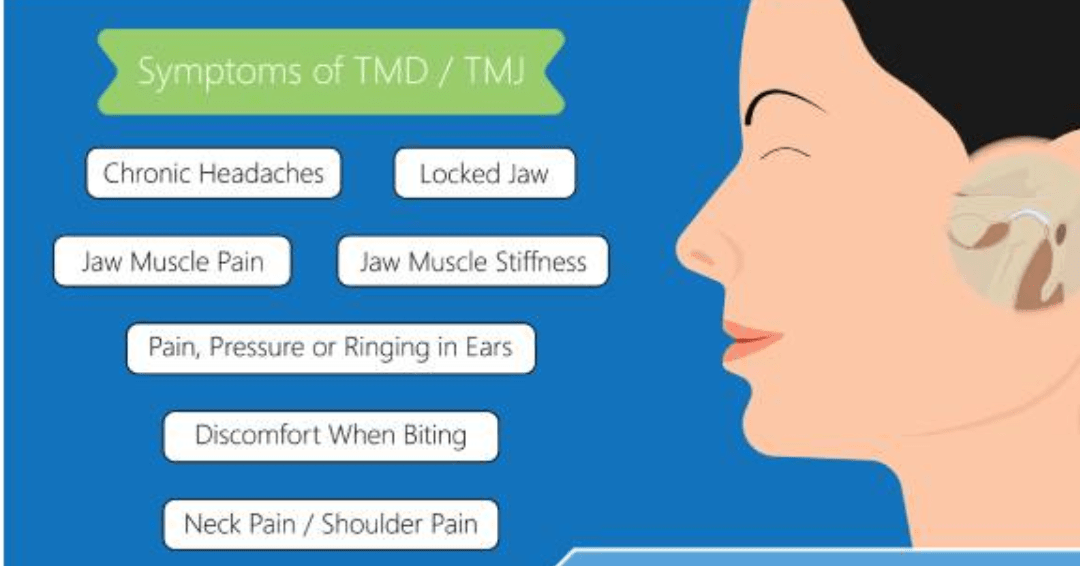
Symptoms generally fall into three groups. Clicking or popping sounds when opening or closing the mouth are usually caused by the disc shifting inside the joint – clicking alone isn’t very significant, since about a third of people have jaw joints that click, but clicking with pain or the jaw getting “stuck” can indicate TMD. Muscle pain is felt in the cheeks (masseter) and temples (temporalis); soreness on waking is often related to nighttime clenching or grinding, which a custom nightguard can help relieve. Joint pain coming from the joint itself is essentially arthritis of the TMJ – and interestingly, some people have arthritic-looking joints on X-ray with no symptoms, while others have significant symptoms but normal-looking joints.
Common TMD symptoms include:
- Jaw pain, headaches, and earaches
- Pain in the neck or shoulders
- Difficulty opening the mouth wide, or a jaw that “locks” open or closed
- Clicking, popping, or grating sounds in the jaw joint
- A tired feeling in the face, or difficulty chewing
- Tinnitus (ringing in the ears)
- Changes in the way the teeth fit together
- Swelling on the side of the face, or tooth pain
TMD Treatment Options
The standard approach moves from conservative, reversible options toward more aggressive, irreversible ones only when necessary. A typical progression of conservative care looks like this:
- Education and evaluation – have a dentist examine the TMJ, get imaging if needed, and learn the options.
- Soft foods – temporarily reduce stress on the muscles and joints.
- Ice or heat – applied to the jaw muscles or inflamed joint.
- Gentle stretching – small, gentle movements for inflamed or spasming muscles.
- Jaw exercises – retraining and stretching for the muscles around the TMJ.
- Pterygoid massage – massaging these chewing muscles can reduce TMD-related tension.
- Medications – anti-inflammatories, muscle relaxants, or a cortisone injection in more severe cases.
- Bite appliance – a custom night guard to reduce clenching and grinding forces.
Only when conservative care is exhausted are more aggressive, irreversible options considered: bite adjustment, orthodontics, crowns or bridgework, and surgery.
Exercises and Stretches for TMD
Cervical Retractions
Sit or stand with good posture, looking forward. Tuck your chin to create a “double chin,” hold for 3-5 seconds, then return to the start. Keep your gaze fixed on a spot to avoid tilting the neck, and keep your mouth closed. Perform one set of 10 repetitions, 3-10 times per day. You can also do this with your back against a wall, tucking the chin until the base of the skull contacts the wall.
Chin Depression
With good posture and your ears over your shoulders, place the tip of your tongue on the roof of your mouth just behind your front teeth (as if to say “N”). Slowly open your mouth while keeping your tongue in place, making sure your chin doesn’t jut forward. Close and repeat for 10 repetitions, hourly or as directed.
Masseter Stretch
Sit at a table with your elbow on it and your forehead resting in that hand. With your other hand, gently and firmly pull your jaw downward until you feel resistance. Lightly contract your jaw against your hand for 10 seconds without letting it close, then relax and ease the stretch further. Repeat one set of three, twice per day or as directed.
Mandibular Stabilization
With good posture, place your tongue tip on the roof of your mouth (the “N” position) and open slightly. Holding that position, apply gentle six-second pressures to your jaw with a finger – downward, upward, and side to side. Repeat the series six times per day or as directed.
A pterygoid release technique is also helpful for TMD, but because it involves working inside the mouth along the jaw, it’s best performed by a trained provider rather than self-administered.
Summary
Non-surgical care for TMD has been shown to be as effective as surgical intervention, so management should stay conservative and simple, focusing on manual therapy, exercise, and avoiding aggravating activities. Chiropractors can help by adjusting the jaw, joints, and surrounding muscles to improve function and reduce pain, and by teaching the daily exercises and stretches that are proven to be just as effective as – if not better than – more aggressive options.
READY TO FEEL BETTER?
Book Your Appointment Today
Same-week appointments are often available. Call 512-347-8881 or request a time online.
Ready to feel better?
If you are new to our office, learn what to expect on your first visit, or explore the conditions we treat.