
Why Your Back Hurts After Long Drives and Flights, and How to Prevent It
Summer in Austin means road trips to the coast, weekends in Fredericksburg, and flights to see family across the country.
It also means this familiar moment.
Somewhere around hour three, you start shifting in your seat. You lean to the left. Then to the right. You stretch one leg. Roll your shoulders. Sit up straighter. Slouch again.
Nothing seems to help.
By the time you arrive, getting out of the car feels like you’re twenty years older. Most people blame the drive, but the real culprit is something happening inside your spine long before the pain begins.
The good news is that travel-related back pain is usually preventable. With a few simple habits, you can arrive ready to enjoy your trip instead of spending the first day trying to loosen up.
Your Spine Was Built for Movement, Not Stillness
Your spine isn’t a stack of bricks. It’s a living suspension system.
Every step you take, every twist, every reach, and every change in posture spreads force across dozens of joints, muscles, discs, ligaments, and connective tissues. They share the workload beautifully, but only when they’re allowed to move.
The moment you sit for hours, that system changes.
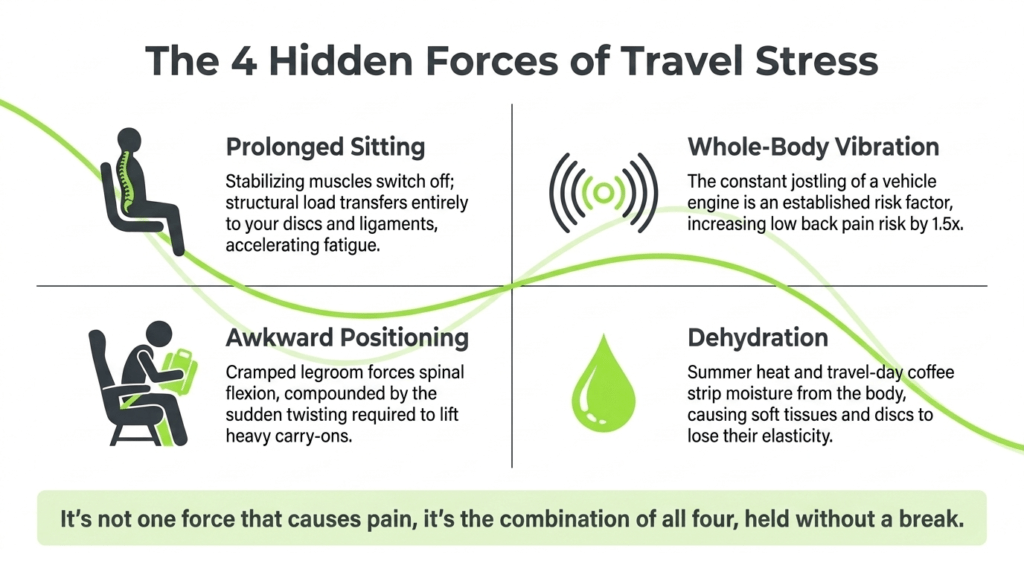
The muscles that normally stabilize your spine gradually become less active. As they contribute less, more of the load shifts onto your discs, ligaments, and joints. Those tissues can absolutely handle the job, but not indefinitely.
Ironically, your back usually doesn’t hurt because you moved too much.
It hurts because you stopped moving altogether.
That’s why so many people feel fine during the drive, only to stand up at a gas station or airport and suddenly realize how stiff they have become. The stress has been quietly accumulating the entire time.
One of my favorite reminders for patients is this:
The best posture isn’t perfect posture. It’s your next posture.
Four Reasons Travel Makes Your Back Angry
1. Prolonged sitting
Sitting isn’t bad.
Staying in one position for four straight hours is.
Your spine doesn’t need a gym workout every hour. It simply needs variety. Small position changes keep tissues healthy by sharing the load instead of concentrating it in one place.
2. Constant road vibration
This one surprises almost everyone.
Researchers call it whole-body vibration, and at the wrong frequency/oscillation, it has been linked to an increased risk of low back pain. A large systematic review found people with greater exposure to vehicle vibration had about a 50 percent higher risk of developing low back pain and sciatica than those with lower exposure.
Think about bending a paperclip. One bend doesn’t break it. Thousands of tiny bends eventually do.
The vibration from a vehicle isn’t violent enough to injure your back in a single moment. It’s the thousands of small jolts over several hours that gradually fatigue the muscles and connective tissues supporting your spine.
You don’t have to drive an eighteen-wheeler for this to matter. A day behind the wheel to Port Aransas can be enough to notice the difference.
3. Awkward positions
Airplane seats, cramped cars, twisting into the back seat for a backpack, lifting luggage into an overhead compartment, wrestling a suitcase off the baggage carousel.
None of these movements are dangerous by themselves.
They’re simply harder on tissues that have already been sitting still for hours.
Interestingly, many travel-related back strains don’t happen during the drive or flight.
They happen within seconds after it ends.
4. Dehydration
Austin summers don’t exactly encourage hydration.
Travel often means extra coffee, airport snacks, salty meals, and not nearly enough water.
While hydration isn’t a magic cure for back pain, well-hydrated tissues generally tolerate prolonged sitting and movement better than dehydrated ones. Staying hydrated also makes it easier to keep moving throughout your trip.
Before Turning the Key
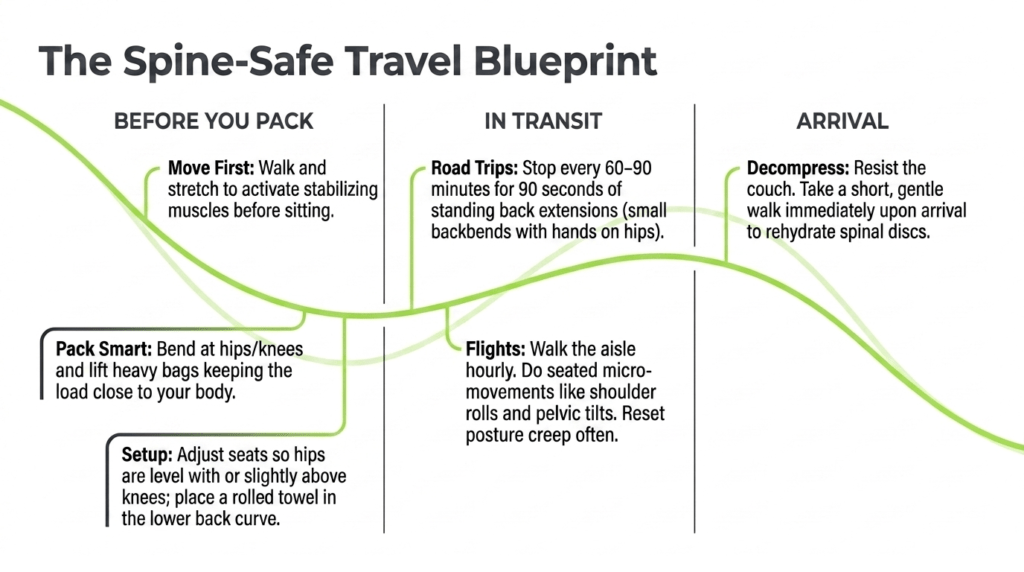
The easiest back pain to treat is the kind you never create. Spend five or ten minutes moving before you leave.
- Go for a short walk.
- Perform a few gentle stretches. I
- f we’ve given you a home exercise routine, today is the day to use it.
Then set up your seat.
- Your hips should sit level with or slightly above your knees.
- Move close enough to the pedals that you’re not constantly reaching.
- Place a small lumbar support or rolled towel in the natural curve of your lower back.
The same trick works surprisingly well on airplanes.
When packing, keep heavy bags close to your body, bend through your hips and knees, and avoid twisting while lifting.
And don’t wait until you’re thirsty to drink water. Start hydrating before your trip begins.
During the Trip, Your Spine Has One Request
Don’t stay still.
If you’re driving, set a timer for about 75 minutes. When it goes off, pull over if it’s safe.
- Walk for two or three minutes.
- Stand tall.
- Place your hands on your hips and gently lean backward a few times. Those small extensions help reverse hours spent sitting in a flexed position.
If you’re flying, get up whenever it’s safe to do so.
Walk the aisle. Back in your seat, keep changing positions. Roll your shoulders. Gently arch and round your lower back. March your feet. Shift your weight.
Your spine doesn’t care whether the movement is impressive. It only cares that it happens.
Myth: “I’ll Stretch When I Get There”
Stretching after arrival certainly helps.
But it isn’t enough.
Five short movement breaks during a four-hour drive are far more valuable than one twenty-minute stretching session after you’ve been sitting the entire time.
Movement works best as prevention, not just recovery.
The First Ten Minutes After You Arrive Matter
You’ve finally reached your destination.
Don’t let your first move be collapsing onto the couch. Take a short walk. Give your spine a chance to decompress. Drink water.
If your back feels tight, gentle movement is almost always better than complete rest. Mild heat can also help relax muscles that have been working overtime.
Most travel-related stiffness settles within a day or two because it’s usually a response to prolonged stillness, not a sign of injury.
When Its Time to Get Checked
Some pain is expected. Persistent pain isn’t.
If your back continues hurting for several days, keeps returning after every trip, interferes with sleep, or limits the activities you traveled to enjoy, it’s worth getting evaluated.
Chiropractic care is one of the evidence-based, drug-free options for low back pain; clinical guidelines from the American College of Physicians list spinal manipulation among the recommended non-pharmacologic approaches (Ann Intern Med, 2017, PMID 28192789).
More serious signs and symptoms include pain that is shooting pain down the leg that won’t ease, numbness or weakness in a leg or foot, or any loss of bladder or bowel control. These are less common, but they’re worth taking seriously.
Travel Should Be the Fun Part
Your back isn’t fragile. It’s adaptable.
But even adaptable tissues have limits. The goal isn’t to survive the drive. The goal is to arrive with enough energy to enjoy why you traveled in the first place.
- Move often.
- Support your spine.
- Stay hydrated.
- Lift with intention.
Your vacation should begin when you arrive, not after your back finally loosens up.
Call 512-347-8881 or request an appointment online. Same-week appointments are often available. We serve Austin, West Lake Hills, Rollingwood, Bee Cave, Lakeway, Sunset Valley, Tarrytown, and the greater Austin area from our office at 3736 Bee Caves Rd #9, Austin, TX 78746.

This article is for general education and isn’t a substitute for personalized medical advice. If you have a specific health concern, please consult a qualified professional.
Ready to feel better?
If you are new to our office, learn what to expect on your first visit.