
What Is the Best Sleeping Position for Low Back Pain?
Your sleeping position is one of the most overlooked factors in spinal health. During sleep, the body works to restore and repair itself, and the position you sleep in can either help or hinder that process. It’s very common to wake up with low back pain, neck pain, or stiffness simply because of how you slept.
We spend roughly a third of our lives asleep, so choosing a position that supports physical recovery matters. A good sleep position relieves stress on the spine, while a poor one can increase pain or stiffness in the back, shoulders, and arms, and lower the quality of your sleep. Here’s what the research says about the best sleeping positions for low back pain.

What Is the Best Sleeping Position?
The best sleep position is one that maintains healthy spinal alignment from your hips all the way to your head. Exactly what that looks like depends on your body, your weight, and what feels comfortable – so the best position for you may be completely different from your partner’s. That said, some positions are generally considered healthier than others, and research confirms that sleep posture can increase or decrease spinal pain, and that adjusting it can reduce symptoms over time.
The Main Sleeping Positions
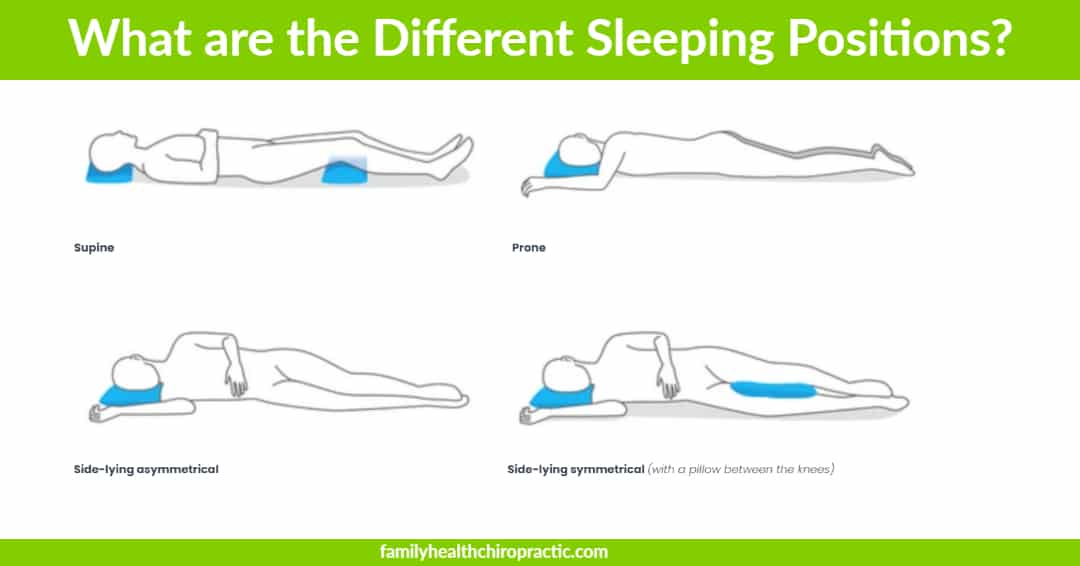
There are four primary sleeping positions:
- Supine – sleeping on your back
- Prone – sleeping on your stomach
- Side-lying, asymmetrical – on your side with no pillow between the knees
- Side-lying, symmetrical – on your side with a pillow or support between the knees
For people with low back pain, sleeping on the back or side is generally considered more beneficial than sleeping on the stomach, because it’s easier to keep the spine supported and balanced, relieving pressure on the spinal tissues so the muscles can relax and recover. That said, if stomach sleeping genuinely feels good to you, don’t feel forced to change it – simply getting enough sleep matters more than chasing a perfect position, and a good mattress and pillow can help with alignment. In one study, adults with back pain who were trained to sleep on their back or side experienced significant pain relief in just four weeks. Adjusting to a new position takes patience, and pillows can help train your body into it.
Two Simple Tests to Find Your Preference
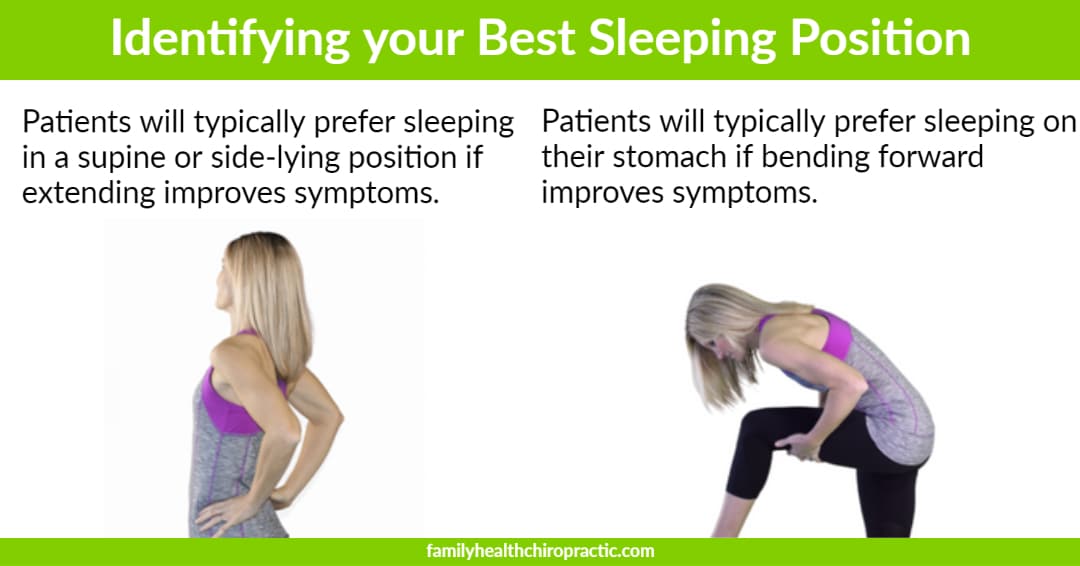
Directional preference is a useful way to figure out which position may suit you. It comes down to whether a flexion (bending forward) or extension (bending back) bias feels better. To test, perform repeated end-range movements and notice whether your symptoms centralize (move toward the spine, a good sign) or peripheralize (spread outward).
Extension testing progresses through these stages:
- Standing extension (stand and bend back)
- Lying prone (on your stomach)
- Lying prone propped on your elbows
- Lying prone and pressing up on extended arms
- Repetitive extension, 1-5 sets of 10 repetitions or until symptoms change
If you feel better after these, you likely have extension-biased low back pain and may be more comfortable on your stomach – sometimes with a pillow under the chest for added support.
Flexion testing is simpler:
- Lie on your back and bring your knees to your chest
- Standing, bend forward
If flexion movements feel better, you likely have flexion-biased low back pain and may be more comfortable on your back or side.
Structural Conditions That Affect Sleep Position
Several clinical conditions strongly influence which position works best:
- Spondylosis (age-related spinal degeneration and arthritis)
- Spondylolisthesis (a forward slip of one vertebra over the one below)
- Osteoporotic compression fractures
- Maigne syndrome (thoracolumbar junction syndrome)
- Uneven hips
- Pregnancy-related low back pain
For both spondylosis and spondylolisthesis, it’s generally best to avoid stomach sleeping. Osteoporosis is the most common metabolic bone disorder and is responsible for more than half a million vertebral compression fractures each year; people with severe osteoporosis or compression fractures may not tolerate back sleeping and should consider side sleeping. Maigne syndrome – a frequently overlooked cause of pain in the low back, iliac crest, and buttock, arising from irritation of a thoracolumbar nerve between T9 and L2 – can be aggravated by asymmetrical side sleeping.
The Bottom Line
Because every spine is unique, there’s no one-size-fits-all sleeping position. Research suggests the optimal position is simply the one that lets you rest most comfortably without after-effects. Finding it usually takes some experimentation: progressively test whether symptoms increase or decrease before committing significant time to a new position. Some research even suggests that people with back pain may benefit from alternating positions throughout the night.
READY TO FEEL BETTER?
Book Your Appointment Today
Same-week appointments are often available. Call 512-347-8881 or request a time online.
Ready to feel better?
If you are new to our office, learn what to expect on your first visit, or see our full range of chiropractic services.